Map every regulation to the exact course module, give each one a named owner and a fixed update SLA, patch only the affected modules, re-certify only the affected audiences, and log versions so the change is audit-ready.

Why mid-year regulatory changes break HR compliance training (and what "current" really means)
Most compliance calendars assume a tidy annual rhythm: build in Q1, assign in Q2, chase stragglers in Q4. Agencies and state legislatures ignore that rhythm entirely. A rule can land in April and change what your supervisors are legally required to hear.
The EEOC published its Enforcement Guidance on Harassment in the Workplace on April 29, 2024, according to law firm Sullivan & Cromwell. That is a late-April publication date for guidance that touches content most employers had already locked and launched.
Budgets do not stretch to absorb surprises. U.S. training expenditures fell 3.7 percent to $98 billion in 2024, according to Training magazine’s annual Industry Report. Mid-year rework competes with work you already paid for.
"Current" needs a working definition or you cannot tell whether you pass. Apply three tests:
- Content test — the module matches the rule as published, including thresholds, hour minimums and covered populations.
- Coverage test — every worker the rule covers has completed the updated version, not an earlier one.
- Evidence test — a dated record links each named person to a specific course version and jurisdiction.
Fail any one of the three and you are current in intention only. The five steps below close all three gaps.
Step 1 — Build a regulation-to-course map and a watchlist of trigger sources
Time: two to three working sessions. What you need: an LMS course export, your employment counsel’s alert list, and headcount by work location.
You cannot patch what you cannot locate. Start by listing every mandatory rule your workforce is subject to, then point each one at the exact module that carries it — not the course title, the module. A row that says "harassment prevention — HAR-CA course" is useless at 4 p.m. on the day a change drops.
| Regulation | Jurisdiction | Who it covers | Course + module | Owner | Source to watch |
|---|---|---|---|---|---|
| Harassment prevention training | California | Employers with 5+ employees | HAR-CA, modules 2–4 | Senior HR Manager | California Civil Rights Department |
| Harassment prevention training | New York State | All employers | HAR-NY, modules 1–3 | Senior HR Manager | NY State Department of Labor |
| OSHA general industry topics | Federal | Covered worksites | SAFE-01, modules 3–6 | EHS Director | OSHA newsroom |
California law requires employers with 5 or more employees to provide 1 hour of sexual harassment and abusive conduct prevention training to nonsupervisory employees, according to the California Civil Rights Department. Scope details like that belong in the map, because they decide who gets reassigned later.
Your watchlist should name sources, not categories: the Federal Register, OSHA’s newsroom, each state agency page you are subject to, two outside-counsel alert feeds, and your industry association bulletin. Assign one person to read them weekly.

Step 2 — Set change triggers, owners and a fixed update SLA
Time: one half-day workshop with legal, L&D and communications. What you need: the map from Step 1 and a named decision-maker.
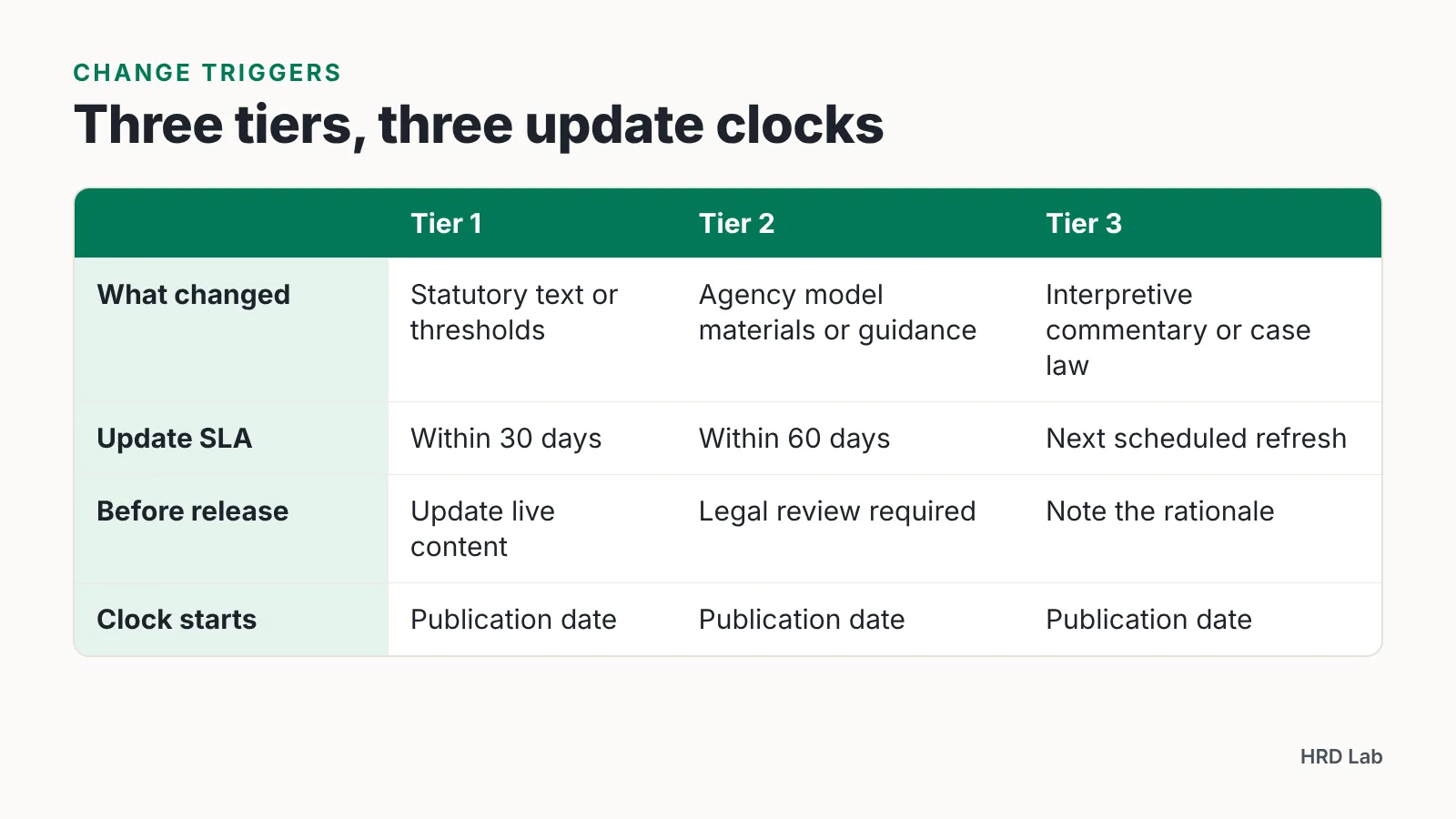
A trigger is a written rule that converts a published change into a dated task. Without tiers, every alert feels urgent and nothing moves. Sort incoming changes into three tiers and attach a clock to each:
- Tier 1 — statutory text, mandated minimums or covered-employer thresholds change. Update live content within 30 days of the publication date.
- Tier 2 — an agency updates model materials or enforcement guidance. Update within 60 days, with legal review before release.
- Tier 3 — interpretive commentary or case-law trends. Queue for the next scheduled refresh and note the rationale.
The New York State Department of Labor finalized updated sexual harassment prevention materials, including model training content, on April 11, 2023, according to law firm Cooley — a mid-year change employers had to absorb. Model-content updates are exactly the Tier 2 case your SLA should already cover.
Start the clock on the publication date, not the day someone forwarded the newsletter. Name an individual owner per regulation row, never a department. Departments do not miss deadlines; people do, and people can be reminded.
Step 3 — Modularise your courses so you can patch a section instead of rebuilding a program
Time: roughly one course per week to restructure. What you need: editable scripts, media assets stored per module, and a naming convention.
Monolithic courses are the reason 30-day SLAs fail. If one 45-minute file contains federal rules, California specifics and New York specifics, every small change forces a full re-export and a full re-review. Split the content so each legal duty lives in its own module.
Three rules keep modules patchable. One rule per module. Jurisdiction-specific content never shares a module with federal baseline content. Thresholds, hour minimums and deadlines appear in narration and on-screen copy you can edit, not baked into flattened graphics.
Re-recording one module is where video tooling earns its place. AI Studios, DeepBrain AI’s cloud platform for AI avatar videos and translations, can build a video from a script, a topic prompt, a web URL, an uploaded document or a product page, and its Docs to Video feature accepts .ppt, .pptx, .pdf, .doc, .docx, .xlsx and .txt files up to 20 MB. Text-to-speech voiceovers are available in 150+ languages and accents on paid plans, which matters if the same patched module ships to several countries.
Know the limits before you plan around it. The Free plan costs $0 and allows up to 3 AI videos of up to 1 minute each in 720p, so it is a trial rather than a production pipeline, and "unlimited AI video generation" means no cap on video count while length, dubbing minutes and generative credits stay limited by plan. When a change is two sentences of policy wording, a dated email from your CHRO plus manager talking points will reach people faster than any re-render.
Step 4 — Re-deploy and re-certify only the affected audiences, jurisdictions and roles
Time: one to two days of LMS administration per change. What you need: accurate work-location, job-level and hire-date data.
Blasting the whole catalog to every employee is the fastest way to destroy completion rates. Segment first. Four fields carry most of the weight: work location (the actual worksite, not the HQ address on file), job level, worker type including temporary and seasonal staff, and hire date.
Decide re-certification by impact, using a simple rule. If the patched module changes a legal duty, a threshold, a reporting route or a prohibited behavior, require re-completion from the covered group. If the change is wording, pacing or a new example, bump the version and let the next scheduled cycle carry it.
California’s Civil Rights Department states that the next sexual harassment prevention training deadline is January 1, 2027. Anchor your re-deploy plan to dates like that so a mid-year patch and a statutory cycle do not collide into two separate assignments for the same people.
Communicate the reason in the assignment notice. Employees who understand that a state agency updated its model content in April treat the retake differently from a generic "annual training due" reminder.
Step 5 — Evidence the update: version control, completion records and audit-ready reporting
Time: a half-day to set the scheme once, then ongoing. What you need: a change log template, LMS completion exports and an approver signature line.
Versioning is cheap insurance. Use a scheme that reads at a glance — COURSE-JURISDICTION-v2.1 — where the major number changes when a legal duty changes and the minor number changes for wording. Record effective date, source of change, reviewer and approver for every version.
The maximum OSHA penalty for a willful or repeated violation is $165,514 per violation, according to CBIA’s summary of 2025 OSHA civil penalties. OSHA announced there will be no inflation adjustment to its civil penalty amounts for 2026, so those existing maximums carry over, according to the National Association of Home Builders.
Your completion record should hold six fields per learner: name or employee ID, course version, jurisdiction, completion date, assessment result and delivery language. Exports without the version field cannot prove which content someone actually saw.
Build one audit page per regulation, refreshed quarterly. It should show the current version, the date of the last change, the covered population count and the completion percentage for that population. Pull it before an auditor asks, not after.
Your mid-year compliance training update checklist
Run this list the week a change is published. It takes under an hour if Steps 1 and 2 are already in place, and it keeps the handoffs visible across HR, L&D, legal and EHS.
- [ ] Log the change with its publication date and source name
- [ ] Assign the tier (1, 2 or 3) and start the SLA clock
- [ ] Confirm the named owner and a backup owner
- [ ] Locate the affected modules in the regulation-to-course map
- [ ] Check whether the covered-employer threshold or covered population changed
- [ ] Draft revised script copy and send for legal review
- [ ] Re-record or re-publish only the affected modules
- [ ] Increment the version number and update the change log
- [ ] Rebuild the audience segment by location, job level and worker type
- [ ] Decide re-certification versus silent version bump
- [ ] Send the assignment notice explaining what changed and why
- [ ] Set a completion checkpoint before the SLA deadline
- [ ] Export completion records with the version field included
- [ ] Refresh the one-page audit summary for that regulation
Archive the superseded version rather than deleting it. Auditors frequently ask what employees were taught last year, and an overwritten file cannot answer that.
Common mistakes HR teams make when regulations change mid-year
The failure that costs the most is the panic blast: reassigning the full compliance catalog to all employees because one state rule moved. Completion rates collapse, managers start approving exemptions informally, and the one group that genuinely needed the update gets buried in the same queue as everyone else. Avoid it by segmenting before you assign, using the location, job-level and worker-type fields from Step 4.
Four more patterns show up repeatedly:
- Starting the clock late. Teams date the change from when they noticed it, which quietly erases weeks of the SLA.
- Patching the deck but not the assessment. Quiz questions keep testing the old threshold, and the record shows a passing score on outdated content.
- Updating English only. Translated versions drift behind, so your non-English-speaking workforce trains on superseded rules.
- No version field in the LMS export. You can prove someone completed a course, but not which content they saw.
One more worth naming: treating guidance as optional. Enforcement guidance shapes how agencies read employer conduct, even where it does not create a new statutory duty. Review it, decide, and write down the decision.
This is general information about U.S. federal and state training requirements, and rules differ by state and by employer size — it is not legal advice, so confirm specifics with qualified employment counsel for your jurisdictions.
Frequently asked questions
How fast should we update compliance training after a regulation changes mid-year?
Set the deadline before the change arrives. A workable structure is 30 days from the publication date for statutory or threshold changes, 60 days for updated agency model materials or guidance, and the next scheduled refresh for interpretive commentary. Start the clock on the publication date, not the day your team noticed.
Does a mid-year change mean every employee has to retake the course?
No. Re-certify only the people the changed rule covers, segmented by work location, job level, worker type and hire date. California’s Civil Rights Department states that the next sexual harassment prevention training deadline is January 1, 2027, so align mid-year patches with cycles like that instead of launching duplicate assignments.
What records do auditors and regulators actually ask for?
Dated completion records tied to a specific course version, plus the change log showing what was revised, when, by whom and under which approval. The maximum OSHA penalty for a willful or repeated violation is $165,514 per violation, according to CBIA’s summary of 2025 OSHA civil penalties, so paperwork gaps carry real cost.
How do we stop California and New York course versions from drifting apart?
Keep jurisdiction content in separate modules with separate owners and separate version numbers in the LMS. California law requires employers with 5 or more employees to provide 1 hour of sexual harassment and abusive conduct prevention training to nonsupervisory employees, according to the California Civil Rights Department, and New York’s requirements run on their own agency updates.
Is re-recording video worth it for a small mid-year edit?
It depends on whether the change alters a legal duty. For threshold or duty changes, patch the affected module so the record matches the rule. For a two-sentence wording tweak, a dated executive email plus manager talking points usually reaches people faster than any new render.
Sources
- OSHA Increases Civil Penalties for 2025 — CBIA
- Top OSHA Violations of 2025; No Increase in Penalties for 2026 — National Association of Home Builders
- Sexual Harassment Prevention Training For Employees (FAQ) — California Civil Rights Department
- EEOC Issues New Enforcement Guidance on Workplace Harassment — Sullivan & Cromwell LLP
- New York Issues Updated Sexual Harassment Prevention Materials — Cooley LLP
- 2024 Training Industry Report — Training magazine
AI tools helped write this guide. The HRD Lab Editorial Team published it after checking every figure against the sources linked above.