Standardize retail employee training centrally and practice locally: one HQ-built module set, store-level role plays, and a five-day build-translate-publish-verify cycle so 900 seasonal associates in 120 stores learn the same six tasks the same way.

Quick Steps: Five Moves Before the Seasonal Intake
Seasonal programs fail on scope, not on effort. Cut the curriculum to what an associate actually touches in their first three shifts, build those pieces once, and push them to every store in the same hour.
- Name one owner per module. One person at HQ signs off each lesson — not a committee of regional managers.
- Freeze the scope to six floor tasks. Greeting, fitting room, POS sale, returns intake, replenishment, escalation.
- Record master versions centrally. One script, one narrator, one job aid per task, published from a single library.
- Localize only what law or store layout forces. State-specific compliance, the floor map, the name of the manager on duty.
- Verify store by store on Friday. Each manager confirms playback, link access and a signed practice checklist before the first shift starts.
Everything else waits for week two: clienteling, visual merchandising standards, loyalty sign-ups, seasonal promo mechanics. An associate who can greet a customer, ring a sale, take a return and call for help is floor-ready. One who sat through forty slides on brand heritage is not.
The Seasonal Training Squeeze: One Week to Floor-Ready
Throughput, not headcount, is the constraint in November. According to HBSDealer’s coverage of the NRF holiday forecast, retailers are expected to hire between 325,000 and 375,000 seasonal workers, compared with an estimated 356,000 seasonal jobs the previous year. Those hires arrive in a narrow window, scattered across hundreds of stores and several state jurisdictions.
Three pressures collide in that window:
- Calendar. Offers go out in late October, first shifts start in early November, and the Black Friday date does not move.
- Payroll. Training hours sit on the store’s labor line, so store managers quietly shorten them.
- Churn. Some seasonal hires leave in week one, and any content you cannot reissue in minutes becomes a bottleneck.
Treat the week as a publishing deadline rather than a course design project. The question is not how good your deck is. The question is whether a part-time associate in store 47 learns the return policy the same way as an associate in store 112, on the same day, in the language they read fastest.
The Scenario: 120 Stores, 900 Seasonal Associates, Black Friday
Example (hypothetical): a mid-market apparel chain operates 120 stores across eight states and hires 900 seasonal associates for the holiday peak. The L&D team is three people. There are no regional trainers, so every store manager is the trainer by default.
The constraints are ordinary and unforgiving. Offers close on a Friday, first shifts begin the following Monday, and payroll allows a short paid training block per associate. A dozen stores need Spanish-language versions. Three states have their own training obligations that HQ cannot waive.
Define "done" before you build anything. In this example, done by Friday means: every associate has watched the six core task lessons, completed the state compliance module required for their store, practiced two role plays with a manager, and been signed off on the returns desk script. Anything that cannot be verified by Friday does not belong in week one. That single rule kills most of the scope creep that sinks seasonal programs.
Before: How Store-by-Store Seasonal Training Drifts
Without a central master, store managers improvise from memory. ATD Research found that 95 percent of organizations use on-the-job training to build frontline employees’ technical and hard skills, which makes the store manager the de facto trainer in most chains. Shadowing works. Shadowing as the only channel is where drift begins.
Drift shows up in four predictable places:
- Content. One manager teaches exchange-first at the returns desk, another teaches refund-first, and customers compare notes online.
- Timing. Busy stores compress a two-hour block into twenty minutes on the sales floor.
- Evidence. Nobody can produce a record of who received the workplace violence module and when.
- Language. Bilingual associates get a rushed verbal translation from a colleague instead of a reviewed script.
The cost is rarely a training line item. It appears as disputed returns, markdown and discount errors, inconsistent fitting-room coverage, and new hires who need an extra week before their first solo shift. If your onboarding admin is also eating manager hours, the fixes in this guide to automating onboarding without losing the human parts apply directly to seasonal intakes.
After: Hub-and-Spoke, Standardized Centrally and Practiced Locally
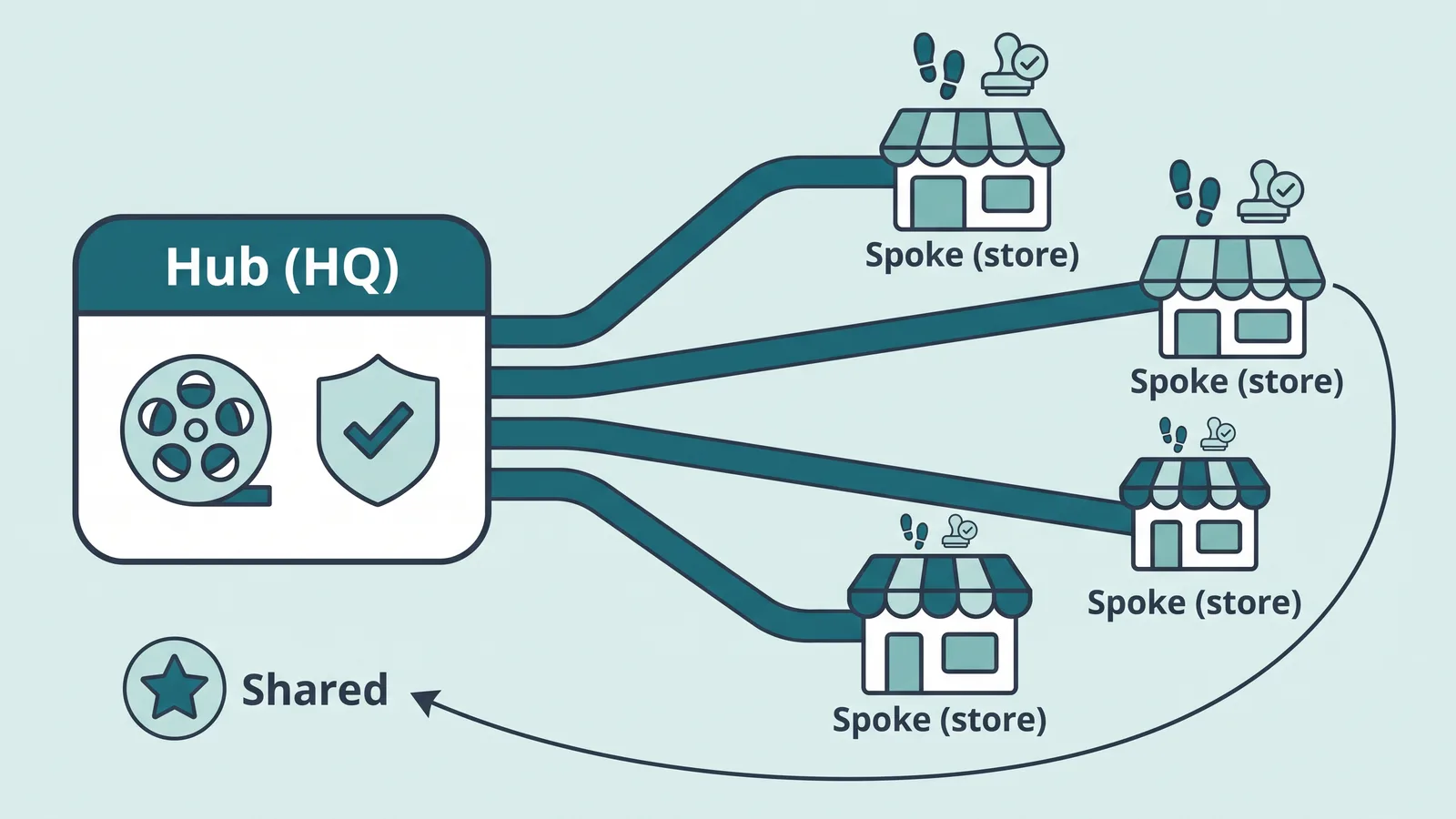
The model splits ownership cleanly: the hub owns what must be identical, the spoke owns what must be physical.
| Layer | Owned by | Contains | Update cadence |
|---|---|---|---|
| Hub (HQ) | L&D lead | Scripts, core videos, job aids, assessments, compliance modules | Reissued chain-wide within a day |
| Spoke (store) | Store manager | Role plays, floor walk, observation, sign-off | Every shift during week one |
| Shared | Ops | Completion data, store scorecard, escalation log | Daily during peak |
Store managers stop writing content and start coaching behavior. That trade is the whole point: you remove the part of the job they do inconsistently and keep the part they do well, which is watching a new associate handle a real customer and correcting them on the spot.
Build the hub once and it carries into January hiring, store openings and next year’s peak. Chains that already run a structured year-round program will recognize the architecture described in this breakdown of custom onboarding training that scales — seasonal is the same system compressed.
The 5-Day Rollout Procedure: Build, Translate, Publish, Verify
Day 1 — Lock scope and scripts
Write the six task scripts and the compliance outline. Keep each script short enough to read aloud in under three minutes. Get the returns policy signed off by the ops lead in writing, because that is the module most likely to change late.
Day 2 — Build the core videos
Most chains already have the raw material sitting in slide decks and policy PDFs. Platforms that import a PPT or PDF and turn each slide into a video scene remove the studio step entirely; AI Studios works this way and offers text-to-speech voiceovers in 150+ languages and accents on paid plans. Record the manager-facing version at the same time.
Day 3 — Translate and localize
Generate the second-language versions of the same scripts, then have a bilingual store manager review them before publishing. Swap in state-specific compliance modules here, not earlier.
Day 4 — Publish and distribute
Push everything to one library, generate per-store links, and send managers a one-page delivery plan. QA every link on a store device, not just on a laptop at HQ. If you want to keep production in-house long-term, this walkthrough of running training video production internally covers the recurring workflow.
Day 5 — Verify store by store
Every store manager confirms playback, completion access and the practice checklist. Ship the core lessons even if one market lags, patch the local module after, and hold the launch in any state where the compliance module is unverified — run a live session there instead.
The Non-Negotiable Compliance Layer
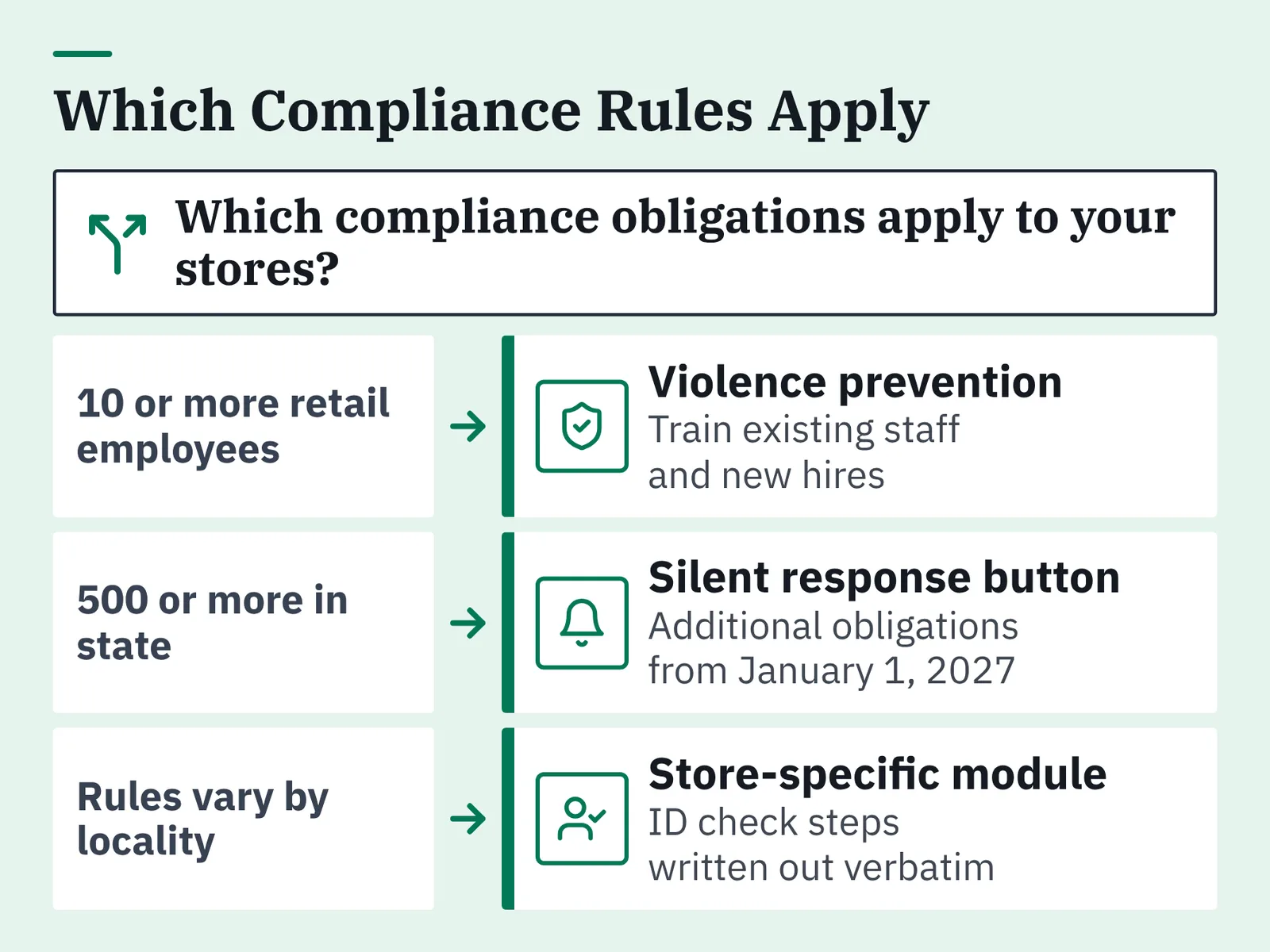
Compliance is the one layer you never delegate to improvisation, and it is state-specific. New York’s Retail Worker Safety Act requires employers with 10 or more retail employees to deliver workplace violence prevention training to existing staff and to new hires upon hire, according to NFIB. Morgan Lewis reports that the New York State Department of Labor issued guidance, a model policy and model training shortly before the Retail Worker Safety Act took effect on June 2, 2025.
Longer-horizon obligations matter for your build plan too. Greenberg Traurig notes that from January 1, 2027, New York’s Retail Worker Safety Act imposes additional silent response button obligations on employers with 500 or more retail employees in the state.
Two more items belong in the seasonal compliance block:
- Age-restricted sales. Rules vary by state and locality and by product category, so the module must be store-specific, with the ID check steps written out verbatim.
- Returns policy. Retail TouchPoints reported that the 2024 US retail return rate was 16.9%, representing about $890 billion in merchandise sent back by customers, which makes the returns desk the busiest script a seasonal hire will use.
Keep the evidence trail machine-readable: who completed what, in which store, on which date. If your compliance calendar is already crowded, these six fixes for annual compliance training pair well with a seasonal push. This is general information, not legal advice — confirm your obligations in each state with counsel.
Content That Travels: Microlearning, Video and Job Aids
Content that survives a store rollout shares a shape. One task per lesson, under three minutes, a single job aid that fits one page, and a manager script that tells the store exactly what to say before and after playback.
Conflict handling deserves a dedicated lesson, not a bullet. Axonify’s 2024 Deskless Report found that 51% of frontline managers and one-third of frontline workers want more conflict resolution training for handling customer conflict — and the holiday returns line is where seasonal staff meet it first.
Practical format rules:
- Show the counter, not the policy. Film or animate the actual transaction sequence, including where the associate stands.
- Caption everything. Stockrooms are loud and phones get muted.
- Print the job aid. A laminated card at the register beats a link nobody opens mid-shift.
- End with one decision. Each lesson should close on the rule the associate applies when they are unsure.
Proving Consistency: Store-Level Scorecards for Week One
Chain-wide averages hide the stores that are failing. Report at store level, daily, for the first seven days.
| Metric | How to read it | Week-one action |
|---|---|---|
| Completion by store | Any store under the chain median | Call the manager, check device access |
| Compliance sign-off rate | Must be 100% before a solo shift | Block scheduling until signed |
| Time to first solo shift | Compare stores, not individuals | Shadow the slow store’s role plays |
| Assessment pass on first attempt | Low pass rate means unclear script | Re-record the lesson, not the quiz |
| Returns escalations per shift | Rising after day three | Re-run the returns role play |
Time-to-productivity is the number your ops director cares about, so define it once and keep it stable: the first shift an associate works the floor without a buddy. Track manager hours spent on training too, since the hub-and-spoke model should pull that number down while completion goes up. Teams automating the reporting side will find useful options in this roundup of AI tools that save HR real hours.
Run a 15-minute review on day 7. Keep what the scorecard proves, rebuild what it flags, and archive the master set for January.
Frequently asked questions
Can a retail chain really train seasonal staff in five days?
Yes, if you cut scope to the six tasks an associate touches in their first three shifts and build centrally. The five-day sequence is lock scripts, build videos, translate, publish, then verify store by store on day five before any solo shift.
What workplace violence training do retail employers in New York have to provide?
New York’s Retail Worker Safety Act requires employers with 10 or more retail employees to deliver workplace violence prevention training to existing staff and to new hires upon hire, according to NFIB. Morgan Lewis reports the state Department of Labor issued guidance, a model policy and model training shortly before the law took effect on June 2, 2025. Other states differ; this is general information, not legal advice.
How many seasonal workers are retailers hiring this holiday season?
According to HBSDealer’s coverage of the NRF holiday forecast, retailers are expected to hire between 325,000 and 375,000 seasonal workers, compared with an estimated 356,000 seasonal jobs the previous year. Plan training throughput against your own share of that wave, store by store.
Should store managers still run on-the-job training if content is centralized?
Yes. ATD Research found that 95 percent of organizations use on-the-job training to build frontline employees’ technical and hard skills. Centralizing scripts and video removes the part managers do inconsistently, leaving them the role plays, floor observation and sign-off that only happen in a store.
Which seasonal module matters most for the holiday peak?
The returns desk script. Retail TouchPoints reported that the 2024 US retail return rate was 16.9%, representing about $890 billion in merchandise sent back by customers, and Axonify’s 2024 Deskless Report found 51% of frontline managers want more conflict resolution training for handling customer conflict.
Sources
- NRF predicts blockbuster holiday sales — HBSDealer
- On-the-Job Training for Frontline Employees — ATD
- Global study: Axonify’s 2024 Deskless Report reveals optimism on the frontline but workers & managers are feeling the strain
- ICYMI: Retail Worker Safety Act Effective June 2, 2025 — NFIB
- New York’s DOL Publishes New Guidance, FAQs on Retail Workers Safety Act — Morgan Lewis
- New York Retail Employers, Take Note: New Retail Worker Safety Protection Requirements — Greenberg Traurig
- NRF Forecasts Nearly $850 Billion in Returns in 2025, Slight Decrease from 2024 — Retail TouchPoints
AI tools helped write this guide. The HRD Lab Editorial Team published it after checking every figure against the sources linked above.