Build one global core course, then attach role-specific and country-specific units from a shared component library instead of cloning the whole program — and use cmi5 or xAPI so a single package tracks every variant separately.

The real problem: one onboarding program, fourteen role variants, six countries
Onboarding usually starts clean. One deck, one welcome video, one compliance quiz, and every new hire walks the same path for five days.
Growth breaks that arrangement fast. A sales hire needs pipeline stages and demo certification; a support hire needs ticket triage and escalation rules; an engineer needs repo access and on-call etiquette. Map the whole company and you may be staring at fourteen role variants spread across six countries, each with its own HR layer, language preference and local policy module.
Most teams respond by cloning the master course once per combination. Each clone then drifts quietly. The security module gets patched in the Berlin copy but not the Manila one, a product rename lands in four of fourteen, and by the third quarter nobody can say which version a given hire actually completed.
Your reporting makes it worse. The original AICC "CMI" specification was published in early 1993 and supplied the data model that SCORM 1.2 later adopted, according to the University of Geneva’s EduTech Wiki. That inheritance is why many legacy onboarding courses still exchange only a fixed set of tracking fields with an LMS, flattening fourteen different experiences into one completion flag.
Scenario: a 400-person SaaS firm onboarding a Berlin account executive and a Manila support rep in the same week
Picture a 400-person SaaS company with two hires starting the same Monday. Lena joins as an account executive in Berlin. Rafael joins as a tier-one support rep in Manila, working a shift that overlaps US afternoons.
Both need the same company story, the same security and acceptable-use training, the same product fundamentals, and the same benefits enrollment walkthrough. That shared material is the core. It does not change because of a job title or a time zone.
Lena then needs pipeline stage definitions, discovery call structure, the demo certification checkpoint, and German-language versions of her HR policy acknowledgments. Rafael needs ticket severity levels, escalation paths, the shift handover ritual, and his own local HR layer. Neither needs the other’s material, and neither should sit through it.
The failure mode is obvious once you name it. If your L&D team builds "Onboarding — AE Germany" and "Onboarding — Support Philippines" as two complete courses, you now maintain two copies of the security module forever. Multiply that by fourteen roles and the maintenance cost eats the entire L&D calendar.
The core-plus-variant model: what stays global, what flexes by role, what flexes by location
Split the program into three layers and assign each one a single owner. The core is identical everywhere. The role layer changes by job family. The location layer changes by country, legal entity or language.
| Layer | Typical contents | Owner | Refresh cadence |
|---|---|---|---|
| Global core | Company story, values, security and acceptable use, product fundamentals, systems access basics | Central L&D | Quarterly |
| Role layer | Tool-specific workflows, role KPIs, certification checkpoints, shadowing plan | Role owner (sales enablement, support lead, engineering manager) | Quarterly, or on tool change |
| Location layer | Local HR policy acknowledgments, country-specific benefits, payroll onboarding, language track | Local HR partner | At least annually, plus on policy change |
The discipline that makes this work is a ban on duplication. A module lives in exactly one layer, and any variant that needs it links to the same source asset. When the security module is rewritten, every hire in every country receives the rewrite the next time they launch.
Draw the line early on language. Translating the core is a location-layer job; rewriting the core because a country "does it differently" is usually a sign the core was written too specifically in the first place.
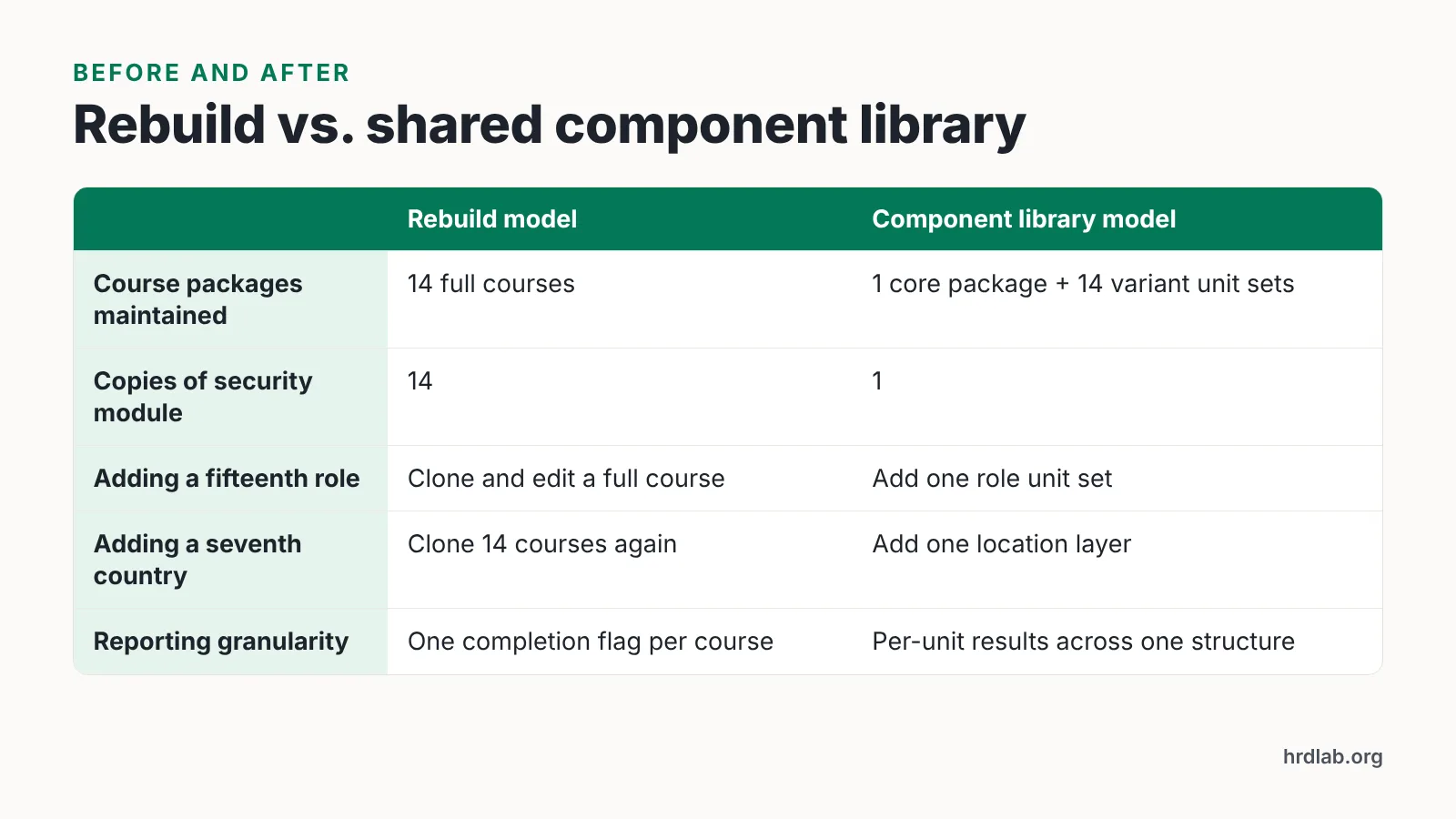
Before and after: rebuilding the whole course each time vs. assembling from a shared component library
The rebuild approach produces one finished course per audience. The assembly approach produces one core plus a shelf of reusable units that get bound together per audience. The difference shows up in every maintenance task you run afterward.
| What you touch | Rebuild model | Component library model |
|---|---|---|
| Course packages maintained | 14 full courses | 1 core package + 14 variant unit sets |
| Copies of the security module | 14 | 1 |
| Adding a fifteenth role | Clone and edit a full course | Add one role unit set |
| Adding a seventh country | Clone 14 courses again | Add one location layer |
| Reporting granularity | One completion flag per course | Per-unit results across one structure |
Those counts describe the scenario above, not a published benchmark — run the same math on your own role map before you commit. The point is the shape of the curve: rebuilding scales with roles multiplied by countries, assembly scales with roles plus countries.
Language is where the saving compounds. AI Studios lists text-to-speech voiceovers in 150+ languages and accents on paid plans and 30+ languages on the Free plan, according to its pricing page, which matters when your location layer is mostly narration swaps over a stable visual sequence.
The reproducible procedure: a nine-step build for a role- and location-aware onboarding path
Run these nine steps in order. Steps one through three are analysis, four through six are construction, seven through nine are release and control.
- Inventory every existing onboarding asset and tag each one as core, role or location. Anything you cannot tag is a candidate for deletion.
- Build the role-by-location matrix. List job families down one axis and countries across the other, then mark which cells actually have hires.
- Write the core outline first at a level of generality every cell can accept. If a sentence only makes sense in one country, it is not core.
- Produce the core once, including narration, visuals and knowledge checks, and version it with a date stamp.
- Produce role units as standalone assignable pieces — not chapters inside the core — so they can be attached or detached without re-exporting the whole package.
- Produce location layers last, because they depend on the finished core script for translation and on local HR sign-off for policy wording.
- Assemble each variant by selecting core plus one role unit set plus one location layer, then preview end to end as a new hire would see it.
- Publish as a single package with multiple assignable units rather than one package per audience.
- Lock the change process: every edit goes to the source asset in the library, never to a published variant.
Step six is where video tooling earns its place. AI Studios, a cloud platform for AI avatar videos and video translation, can generate narrated scenes from a script, a topic prompt, a web URL, uploaded documents or a product page, and its Docs to Video feature accepts .ppt, .pptx, .pdf, .doc, .docx, .xlsx and .txt files up to 20 MB, according to DeepBrain AI’s help center. One real constraint: SCORM export sits on the Enterprise plan with custom pricing, so a small team on a lower tier will need another path into the LMS. For a hands-on walkthrough of a live admin console, a screen recording narrated by the system owner still beats any avatar video.
Keeping variants trackable: SCORM, xAPI and cmi5 choices that let one package serve many audiences
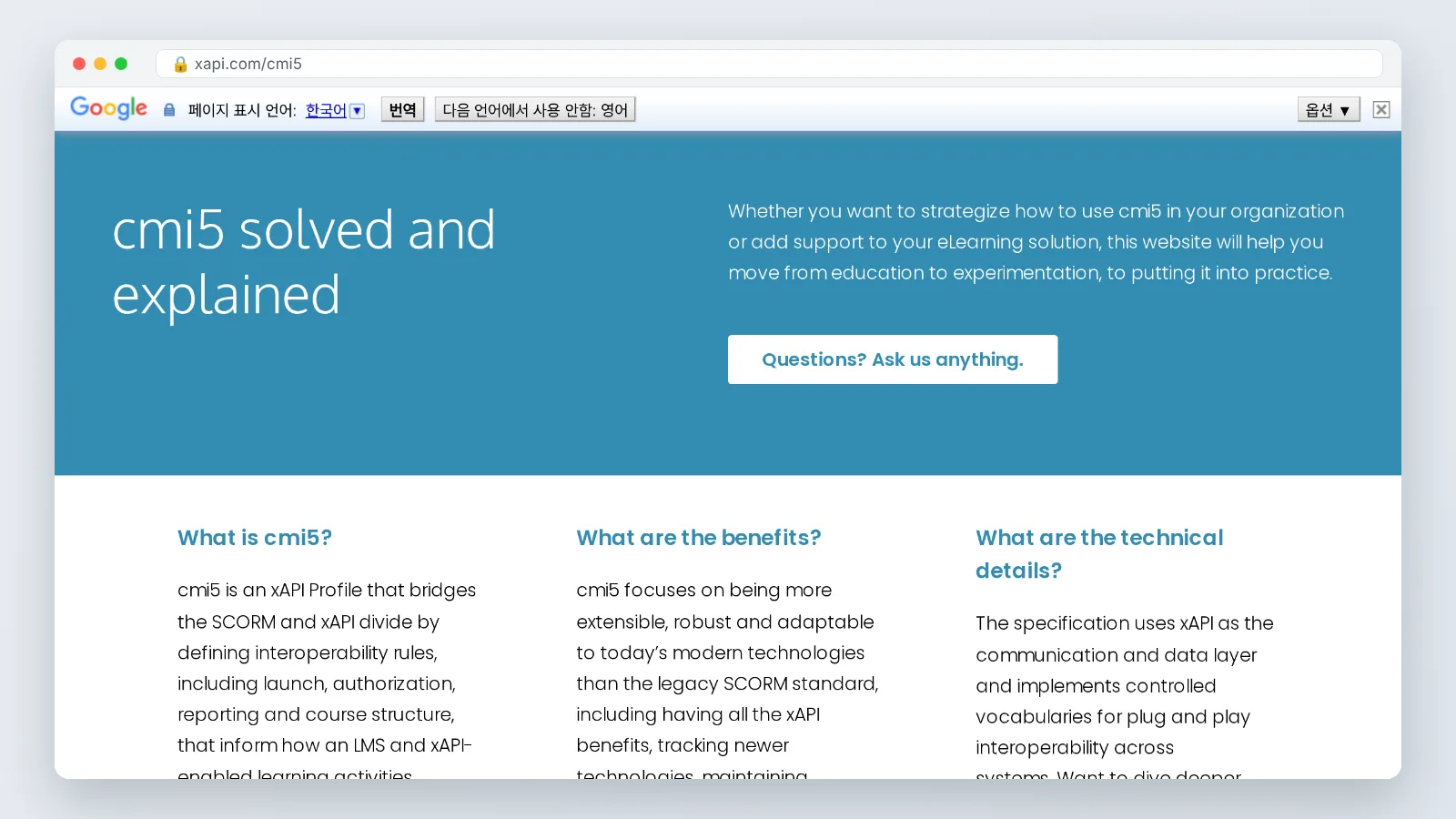
Your standard choice decides whether variant tracking is easy or impossible. cmi5 is an xAPI Profile that defines how online courses are imported, launched and tracked by an LMS, according to Rustici Software’s xAPI.com, which lets you publish one onboarding package and launch role-specific units from it rather than re-authoring a separate course per role.
The structural rules matter as much as the tracking. cmi5 defines interoperability rules covering launch, authorization, reporting and course structure, according to Rustici Software’s xAPI.com, so a shared onboarding course structure can carry different assignable units for different audiences under one import.
| Standard | Fit for role and location variants | Main limitation for onboarding |
|---|---|---|
| SCORM 1.2 / 2004 | Workable if each variant is its own package | Fixed tracking fields; variant proliferation in the LMS |
| xAPI alone | Rich statements from any activity | No defined launch or import rules, so your LMS integration is bespoke |
| cmi5 | One import, multiple assignable units per audience | Requires an LMS that supports it; authoring tools vary |
Check your LMS vendor’s cmi5 support in writing before you redesign anything. If support is absent, keep SCORM packaging but still hold the single-source library behind it, so the rebuild cost stays in publishing rather than in authoring.
Governance: who owns the core, who owns local legal and language layers, and how often each is refreshed
One name per layer, written down. Central L&D owns the core and has veto power over requests to fork it. Each role owner owns their unit set and signs off on tool changes. Each local HR partner owns their country layer, including policy wording and the language track.
Standards stewardship belongs in the same document. In December 2014 the AICC announced it had dissolved and transferred the CMI-5 effort and its document archive to ADL, according to Wikipedia’s entry on the Aviation Industry Computer-Based Training Committee, so treat AICC as legacy and look to ADL for the live specification work.
Set refresh triggers rather than relying on a calendar alone:
- Core: quarterly review, plus immediate update on any product rename or security policy change.
- Role layer: quarterly, plus on any CRM, ticketing or deployment tool migration.
- Location layer: at least annually, plus whenever local HR or counsel flags a policy change.
Requirements for employment documentation, data handling and mandatory training differ by jurisdiction — what a German works council expects is not what a Philippine employer handles the same way, and US state rules vary further. Have local counsel review the location layer before publication. This article is general information, not legal advice.
Measuring it: time-to-productivity, variant build time, and the quarterly review loop
Pick three metrics and resist adding a fourth in the first two quarters.
- Time-to-productivity, defined per role by the hiring manager: first solo demo for an account executive, first independently resolved tier-one ticket for a support rep. Record the date, compare cohorts.
- Variant build time, measured from "new role or country approved" to "variant published." This is the number that proves the library is working; it should fall as the component shelf fills.
- Per-unit completion and assessment results, read at the unit level rather than the course level, which is exactly what a cmi5 structure gives you.
Run the review on a fixed quarterly date with the three layer owners in the room. Each owner brings a short list: what changed in their layer, what new hires asked about that the layer did not answer, and what should be deleted.
Deletion matters more than addition. An onboarding library grows a long tail of units nobody assigns, and those units still show up in audits and translation bills. Kill anything that has not been attached to a published variant in two consecutive quarters, and keep the archive rather than the live asset.
Frequently asked questions
How much of an onboarding program should stay identical across all roles and countries?
Aim to keep company story, security and acceptable use, product fundamentals and systems access basics fully global, and push anything tool-specific or policy-specific into the role or location layer. If a sentence only makes sense in one country, it was never core.
Does cmi5 actually let one package serve several role variants?
Yes. cmi5 is an xAPI Profile that defines how online courses are imported, launched and tracked by an LMS, according to Rustici Software’s xAPI.com, so you publish one onboarding package and launch role-specific assignable units from it instead of re-authoring a separate course per role.
Is AICC still a reasonable standard for new onboarding builds?
Treat it as legacy. In December 2014 the AICC announced it had dissolved and transferred the CMI-5 effort and its document archive to ADL, according to Wikipedia’s entry on the Aviation Industry Computer-Based Training Committee, so new work should follow ADL-stewarded specifications.
What is the fastest way to produce the language layer for a new country?
Translate the finished core script rather than re-recording from scratch. AI Studios offers text-to-speech voiceovers in 150+ languages and accents on paid plans and 30+ languages on the Free plan, according to its pricing page, and supports voice cloning from a short recording.
Which metric best proves the component library is paying off?
Variant build time, measured from the day a new role or country is approved to the day its variant is published. It should drop steadily as the shared unit shelf fills, while time-to-productivity per role stays flat or improves.
Sources
AI tools helped write this guide. The HRD Lab Editorial Team published it after checking every figure against the sources linked above.