Employee training management covers needs analysis, budgets, vendor contracts, assignment rules, instructor logistics, completion chasing, evaluation and audit-ready records — not just booking courses. Scheduling is one task inside a cycle that runs from planning through measurement and retention.
What is employee training management?
Payroll has a system of record. Headcount has one. Training often does not — it sits in a shared spreadsheet, a few inboxes and one coordinator’s memory.
Definition: Employee training management is the coordinated practice of planning, assigning, delivering, recording and evaluating all workplace learning — compliance, onboarding, role skills and leadership — across an organization.
Two words carry that definition: all and evaluating. A course calendar tells you what is happening Tuesday at 10. Training management tells you whether the right people learned the right thing, what it cost, and whether you can prove it to an auditor eighteen months from now.
Demand for the function keeps climbing. LinkedIn’s 2025 Workplace Learning Report found that 91% of L&D professionals agree continuous learning is more important than ever for career success. More programs means more audiences, more evidence and more follow-up.
Part of the job is refusal. A plant manager asks for a half-day workshop in two weeks, and the person managing training answers with a cost, a trainer’s availability and the program that gets pushed to make room. No scheduling tool makes that call for you.
What employee training management includes beyond scheduling courses
Booking a session is one link in a long chain. The other links are where programs quietly fail.
- Needs analysis — turning an incident log, a performance gap or a new regulation into a training decision, including the decision not to train.
- Curriculum and version control — knowing which version of the harassment module people completed in March, and what changed in the rewrite.
- Assignment rules — who gets what, triggered by role, site, shift, contract type and hire date.
- Instructor and vendor logistics — contracts, day rates, room bookings, accessibility and interpreter requests, cancellation terms.
- Records and retention — signed rosters, assessment scores, certificates, expiry dates, and how long each one is kept.
- Budget tracking — committed versus spent, broken down by program and business unit.
- Evaluation and follow-through — completion, assessment results, manager observation, and the operational number the program was meant to move.
- Communication — invitations, reminders, manager escalation, and the third awkward email to the twelve people who have not finished.
Volume exposes every weak link. A seasonal hiring wave makes that obvious: moving a large intake through onboarding and safety training against a hard start date is a logistics problem long before it is a content problem.
Notice how few of those eight tasks involve a course at all. They are coordination, evidence and money.
How employee training management works: plan, deliver, measure
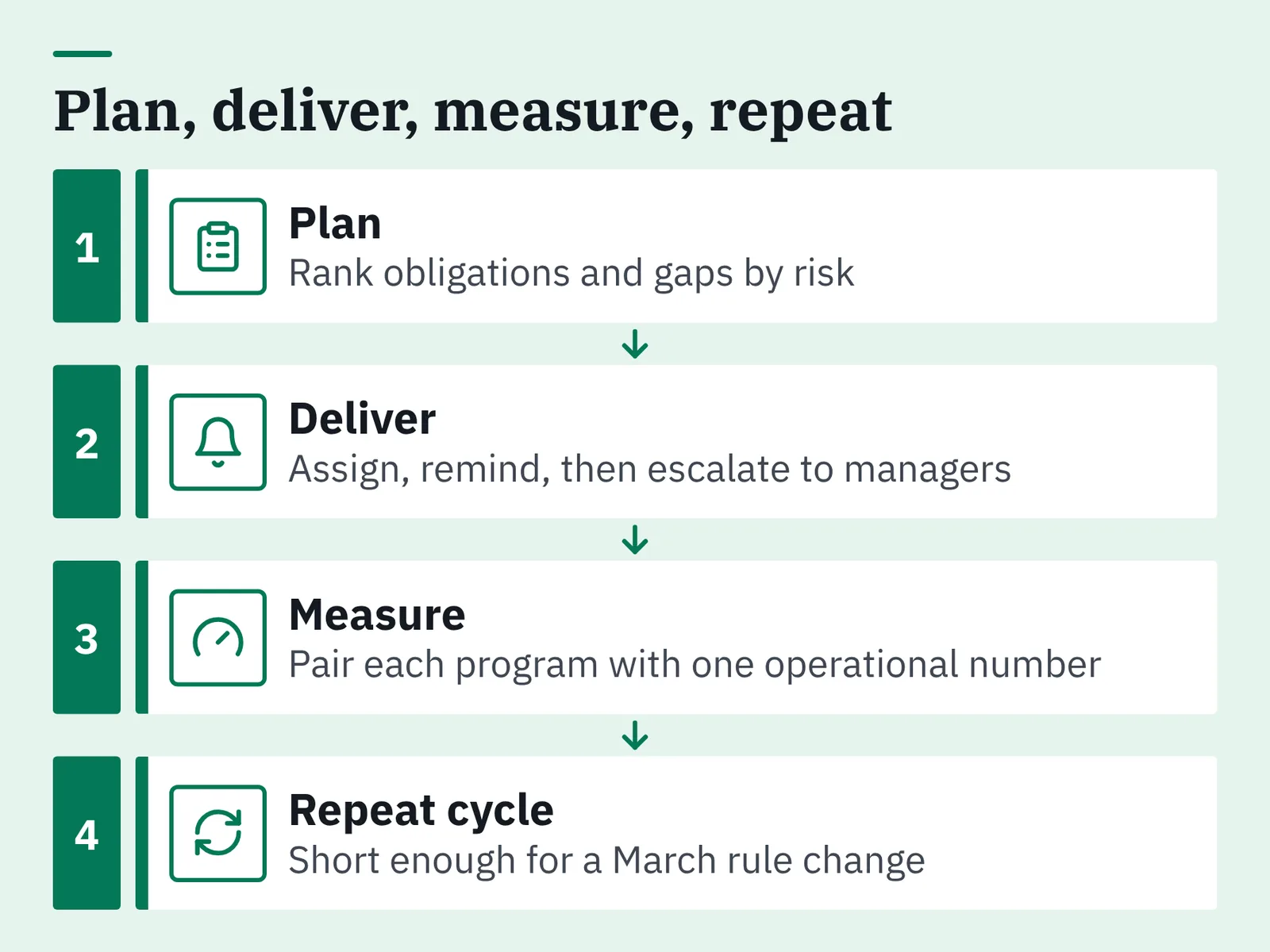
Three stages, run on a repeating cycle. Keep the cycle short enough that a rule change in March does not wait for next January’s planning meeting.
1. Plan
Start from obligations and gaps, never from a vendor catalog. List what law, contract or customer requires; add what incident reports, quality defects and manager requests point to; rank the list by risk and headcount reached. Each surviving program gets an owner, a budget line and a target date before anyone books a room.
2. Deliver
Delivery is assignment, logistics and persistence. Write the audience rule once — every warehouse associate within 30 days of hire, for example — then set a reminder cadence and escalate to the manager, not the employee, after a second miss. Reminder chasing is the first thing worth automating, and the HR tools that actually save hours on routine admin tend to earn their keep on exactly this kind of repetitive follow-up.
3. Measure
Count completions, then move past them. ATD’s 2026 State of the Industry reporting shows average formal learning hours per employee rose to 16.7 in 2025, up from 13.7 hours in 2024. Hours and completion rates describe activity, so pair every program with one operational number — recordable injuries, first-contact resolution, 90-day turnover — and review it a quarter after delivery.
Employee training management vs. a learning management system (LMS)
An LMS is a tool. Training management is the job that may or may not use one.
| Learning management system | Employee training management | |
|---|---|---|
| Primary job | Host, assign and track courses | Run the whole training operation |
| Scope | What lives in the platform | Every format, including on-the-job and vendor-led |
| Instructor-led logistics | Usually sessions and seats | Contracts, day rates, rooms, cancellations |
| Audit evidence | The completion data it holds | Rosters, certificates, evaluations, retention schedule |
| Budget and vendors | Rarely tracked | Core responsibility |
| Breaks down when | Learning happens outside the platform, so the record it holds is only part of the picture | No one owns the decisions |
The confusion is expensive. Teams buy a platform expecting it to decide what to train, then find the platform waiting for that decision as an input. Software records the answer; a person has to produce it.
That is not an argument against buying one. A single source for completion data, automatic expiry flags and self-service reporting saves real administrative hours, and most organizations past a few hundred employees need it.
Example: a 300-person manufacturer with forklifts, three shifts and contract labor runs an LMS for digital modules while hands-on evaluations and vendor invoices sit in a spreadsheet. Workable — until an auditor asks for evidence that spans both.
Compliance, records and certification tracking: what the regulations actually require
The requirements below are US federal OSHA rules for covered private employers. States running their own OSHA-approved plans may add requirements, and other countries regulate training differently.
- OSHA requires employers to re-evaluate every powered industrial truck (forklift) operator’s workplace performance at least once every three years, not just train them once.
- OSHA requires employers to certify that each forklift operator has been trained and evaluated, under 29 CFR 1910.178(l)(6).
- Under OSHA’s bloodborne pathogens standard, the records required by paragraph (h) must be maintained for at least the duration of employment plus 30 years.
Read those as three separate obligations: recurring evaluation, written certification, and retention that outlives the employment relationship. A completion checkbox in a platform satisfies none of them by itself.
Retention is the one that ambushes people. A record kept decades past employment has to survive vendor switches, platform migrations and the departure of whoever built the tracker, which makes your data export policy more important than your reporting dashboard.
Shift-based workforces add a second layer, since coverage and schedules decide who can physically attend — the same constraint on a hospital ward, a plant floor and a depot. This is general information, not legal advice — confirm your obligations with counsel for your jurisdiction and industry.

What training management costs: budgets, benchmarks and software pricing
Start with published benchmarks before defending a number internally. ATD’s 2025 State of the Industry research reported average direct learning expenditure of $1,254 per employee in 2024, a $29 decrease from 2023. ATD’s 2026 State of the Industry reporting shows direct learning expenditure per employee fell from $1,254 in 2024 to $846 in 2025.
Unit cost moved the other way. ATD’s 2025 State of the Industry research reported that the average cost per learning hour used rose to $165 in 2024, about 34 percent higher than the 2023 average of $123.
Do not try to reconcile those figures by multiplying them: spend per employee and cost per learning hour used are built on different denominators — total direct spend divided by headcount in one case, divided by learning hours used in the other — and the numbers quoted here come from two different report years.
Software is only one line in that total. Vendors typically price by active user per month, by tiered user bands, or with a platform fee plus implementation and data-migration charges, and a content library is almost always quoted separately.
Get three answers in writing before signing: what counts as an active user, exactly what the data export contains and in what format, and whether renewal increases are capped. The second question decides how painful your next migration is.
The largest costs rarely appear on an invoice. Backfill for people off the floor, trainer travel, manager time spent chasing stragglers, and the administrative hours of running the cycle usually dwarf license fees in a hands-on workforce.
Putting it to work: practical use cases and a starter checklist
Four situations where the discipline pays for itself:
- Manufacturing and warehousing — recurring equipment re-evaluations, contractor inductions, and evidence that survives an unannounced inspection.
- Multi-site services — the same requirement delivered across shifts and locations without pulling a site below safe staffing.
- Hiring waves — a repeatable onboarding path that does not collapse when 200 people start in one month.
- Regulated transport and healthcare — credential expiry dates tracked per person, with reminders that fire weeks ahead, not the morning after.
Six steps to get control in the first quarter:
- Inventory every required training by role and site, with its legal or contractual source.
- Name a single owner for each program — a person, not a department.
- Build one roster showing who needs what, with completion and expiry dates in the same view.
- Decide where the signed evidence lives and how long each record type is retained.
- Set the reminder cadence and the manager escalation point in writing.
- Attach one operational metric to each program and review it quarterly.
If your calendar is already crowded with mandatory modules, rework the annual compliance cycle before adding anything new to it. Fix the roster and the evidence trail first. The course catalog is the easy part.
Frequently asked questions
Is employee training management the same as an LMS?
No. An LMS hosts, assigns and tracks courses inside one platform, while training management covers needs analysis, budgets, vendor contracts, instructor logistics, evaluation and record retention — including every format that never touches the platform, such as on-the-job evaluations.
Who owns training management in a company with no L&D team?
Usually an HR generalist or an operations manager, often informally. Make it explicit: name one owner per program, give that person authority over the budget line and the schedule, and document where signed evidence is stored before anyone leaves the role.
How long do we have to keep training records?
It depends on the rule. Under OSHA’s bloodborne pathogens standard, the records required by paragraph (h) must be maintained for at least the duration of employment plus 30 years. Other standards and states differ — this is general information, not legal advice.
How much should we budget per employee for training?
Use published benchmarks as a reference point. ATD’s 2026 State of the Industry reporting shows direct learning expenditure per employee fell from $1,254 in 2024 to $846 in 2025, while ATD’s 2025 State of the Industry research reported that the average cost per learning hour used rose to $165 in 2024, about 34 percent above the 2023 average of $123. The two come from different report years and use different denominators, so they are not meant to multiply out.
What should we measure beyond completion rates?
Pair each program with one operational number — recordable injuries, defect rates, 90-day turnover — and check it a quarter after delivery. Track volume too: ATD’s 2026 State of the Industry reporting shows average formal learning hours per employee rose to 16.7 in 2025, up from 13.7 hours in 2024.
Does a one-time safety training session satisfy OSHA?
Not always. OSHA requires employers to re-evaluate every powered industrial truck (forklift) operator’s workplace performance at least once every three years, and to certify that each operator has been trained and evaluated under 29 CFR 1910.178(l)(6). Confirm requirements for your own operations with counsel.
Sources
- 2025 State of the Industry: Talent Development Benchmarks and Trends (ATD Research)
- 2026 State of the Industry Report Indicates Latest TD Trends — ATD
- eTool: Powered Industrial Trucks (Forklift) — Training Assistance | OSHA
- 1910.1030 – Bloodborne pathogens | Occupational Safety and Health Administration
- 2025 Workplace Learning Report | LinkedIn Learning
AI tools helped write this guide. The HRD Lab Editorial Team published it after checking every figure against the sources linked above.