Stop treating completion as the goal: separate the legal minimum from the learning goal, segment people by risk, teach decisions instead of policy text, assess judgment, and spread short refreshers across the year.
Why annual compliance training turns into a click-through exercise (and what "done" should actually mean)
Compliance courses get bought the way flood insurance gets bought: quickly, before a deadline, by someone whose job is to close an exposure. The purchasing decision sits with legal, risk or HR operations. The learning decision never really gets made at all.
Three design habits produce the click-through almost every time. One course is assigned to the entire workforce regardless of role. Seat time becomes the success metric, and the knowledge check is written so nobody can fail it twice.
Employees read that signal correctly. They open the module in a second browser tab, mute it, and answer the questions from the answer pattern rather than the content.
Redefine "done" before you redesign anything. For a cycle to count as finished, you want four things on file:
- A record — who trained, on what, when, delivered by whom.
- Recall — people can name the two or three rules that apply to their job.
- Judgment — people choose correctly in an ambiguous scenario, not an obvious one.
- Escalation — people know who to tell, within what window, and in what channel.
Only the first of those is an LMS report. The other three take design work.
Step 1 — Separate the legal minimum from the learning goal before you design anything
Time: two to three hours. You need your current course list, the statutes that apply in each jurisdiction where you employ people, and your last two years of incident or hotline data.
Draw two columns on one page. The left column is the legal floor — hours, frequency, audience, format, record retention. The right column is the behavior change you actually want this year, written as a verb.
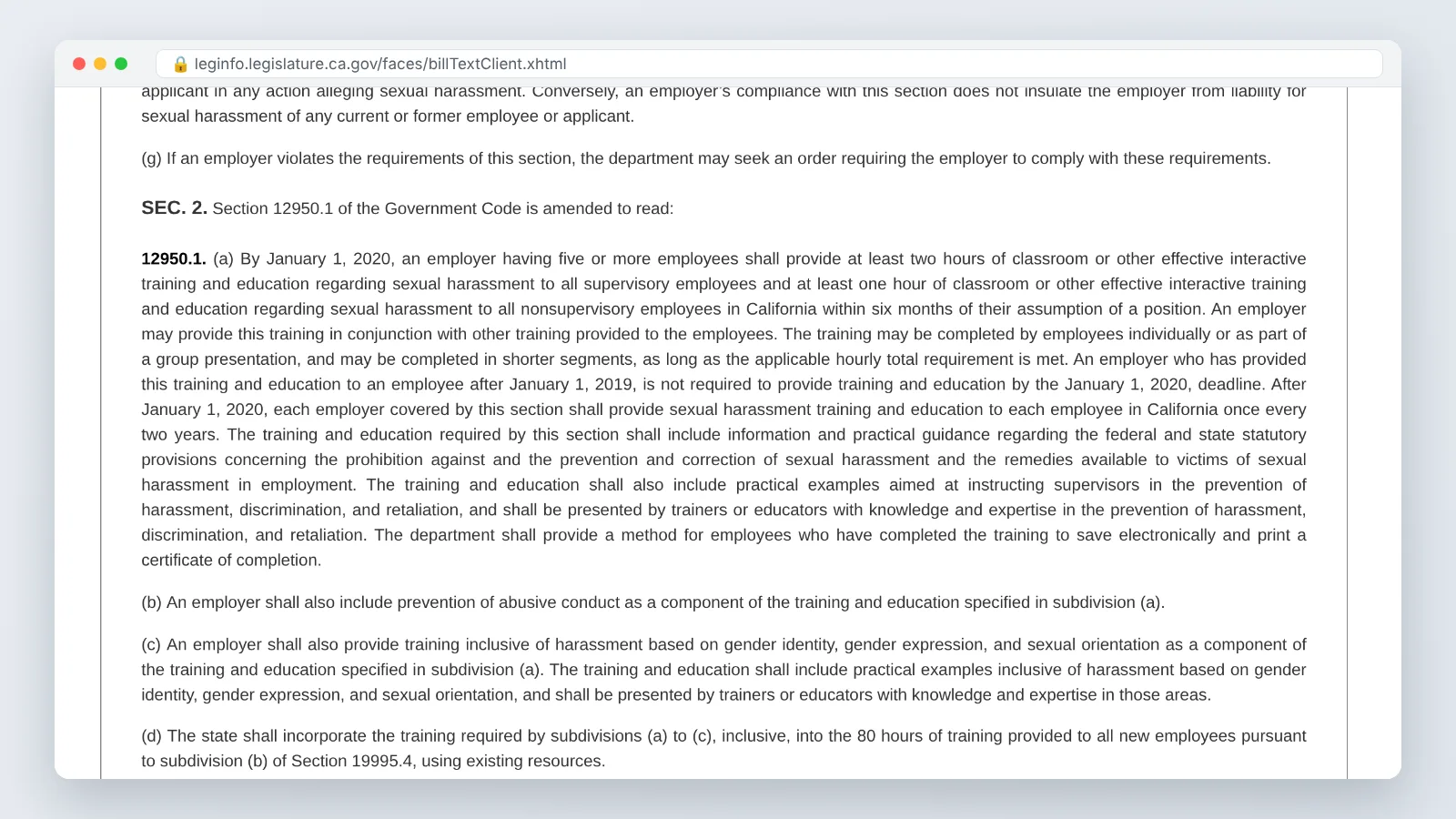
According to California Legislative Information’s text of SB-1343, any employer with 5 or more employees, including temporary or seasonal staff, must provide at least 2 hours of sexual harassment training to every supervisory employee. That is a left-column fact: a floor, a duration, a defined audience.
The right column reads differently. "Frontline supervisors route a complaint to HR within one business day instead of handling it quietly in their team." That sentence cannot be satisfied by a slide.
Keep both columns, and keep them separate. The legal floor tells you what you must deliver and document; the learning goal tells you what the content should be about. Teams that merge the two end up reciting statute language for 120 minutes and wondering why nobody changed.
Mandates also differ by state, country and sector, so build the left column per jurisdiction rather than once for the whole company.
Step 2 — Segment your audience by risk and role instead of assigning one course to everyone
Time: half a day with an HRIS export. You need job families, manager flags, hire dates and location data.
Universal assignment is the cheapest option and the most expensive outcome. A warehouse picker and a regional sales director do not face the same exposure, and both know it within ninety seconds of starting the same generic module.
Segment on two axes: decision authority and contact surface. Who can hire, fire, approve spend or sign for the company? Who touches customer data, cash, children, patients, or vendor relationships?
Statutes often do the segmenting for you. Traliant reports that under California’s SB 1343, seasonal and temporary employees working less than six months must receive their one hour of training within 30 calendar days of hire or within 100 hours worked.
That single rule implies three different delivery paths — a scheduled annual cohort, a rolling new-hire path, and a short-tenure path triggered by hours worked. Build the paths once and let enrollment rules fire automatically.
A practical target: no employee sits through more than two mandatory modules that have nothing to do with their daily decisions.
Step 3 — Rebuild the content around decisions, scenarios and consequences, not policy recitation
Time: one to two weeks per high-risk course. You need a subject matter expert, three anonymized real incidents, and a writer who will cut the policy appendix.
Start from the moment something goes wrong. A team lead gets a message at 11pm. A procurement manager is offered tickets. A nurse is asked to share a login "just for tonight."
Write the scenario in the ambiguous middle, not at the extremes. Obvious misconduct teaches nothing; the useful training sits where a reasonable person could pick wrong.
Format matters legally as well as pedagogically. The guidance in "California SB 1343: Training Hours, Deadlines, and Penalties" notes that California’s required harassment training must be interactive, with supervisors receiving at least two hours and all other employees at least one hour on a two-year cycle.
Interactive is a floor you can clear generously. Give each scenario three plausible options, show the consequence of each — the investigation, the disclosure, the customer call — and let people see the second-order effects rather than a red X.
Keep the policy text as a linked reference, not as narration. Nobody retains a clause read aloud over a stock photo; they retain the moment they chose wrong and watched it unfold.
Step 4 — Replace completion tracking with evidence of judgment: assessment, observation and manager check-ins
Time: ongoing, roughly 20 minutes per manager per quarter. You need a scenario bank, a short manager script, and a record-keeping field in your LMS.
Completion is a receipt, not a result. Keep it — you need it — but stop reporting it as the headline.
Three evidence types do the real work:
| Evidence | What it shows | Who collects it |
|---|---|---|
| Scenario assessment | Correct choice under ambiguity | LMS, scored |
| Manager check-in | Can explain the rule in their own words | Line manager |
| Observation note | Behavior at the actual moment of risk | Supervisor, audit, QA |
Records keep both functions honest. WILL Interactive notes that employers are expected to keep California harassment training records — name, date, training type, provider and completion evidence — for a minimum of 2 years.
Add two fields alongside that record: assessment score and date of the manager conversation. The check-in script should be short enough to run in a one-to-one — ask for one example of a situation that would trigger the policy, and one of what the person would do first.
If a manager cannot answer their own script, you have found your next training audience.
Step 5 — Spread the year: refreshers, nudges and just-in-time micro-modules between annual cycles
Time: one planning session, then an hour a month. You need a calendar of risk moments and a fast way to produce two-to-four-minute videos.
An annual block assumes risk arrives once a year. It does not. Risk arrives when someone gets promoted, when a new vendor is onboarded, when the holiday party is announced, when layoffs start.
Map those moments first, then attach a short module to each. Compliance Training Group notes that newly hired or newly promoted California supervisors must complete their two hours within six months of taking the role, then repeat every two years — a promotion trigger, written into statute.
Production speed is the usual blocker, which is why many L&D teams now script short refreshers and generate them as avatar-led video rather than booking a studio. AI Studios, DeepBrain AI’s cloud platform for AI avatar videos, text-to-video and video translation, can build a video from a script, a topic prompt, a web URL or an uploaded document, and its Docs to Video feature accepts .ppt, .pptx, .pdf, .doc, .docx, .xlsx and .txt files up to 20 MB. One limitation to be clear about: avatar video suits short refreshers and reminders, while the statutory interactive requirements — branching choices, scored questions and a route to ask a trainer — still have to be handled in your LMS.
Keep each refresher to one decision and one action. Send it in the channel people already use, not as a new LMS assignment.
Step 6 — Measure behavior change and feed the data back into next year’s course
Time: two half-day reviews a year. You need hotline volume, case categories, assessment item analysis and manager feedback.
Pick three measures before the cycle starts, and accept that some of them should go up. A rise in reports often means people trust the process, not that misconduct increased.
Useful signals, in rough order of value:
- Time between an incident occurring and it being reported
- Share of reports that arrive through the correct channel
- Repeat findings in the same team or process
- Items where more than a third of learners picked the same wrong answer
That last one is the cheapest redesign input you will ever get. A question everyone fails is either badly written or pointing at a genuine gap, and you can tell the difference by reading the distractor people chose.
California Legislative Information’s SB-1343 text set a baseline of at least one hour of sexual harassment training for all nonsupervisory employees by January 1, 2020, repeating once every 2 years thereafter — which gives you a fixed cadence to plan the review against.
Write a one-page post-cycle memo. Name what you are cutting next year, not only what you are adding.
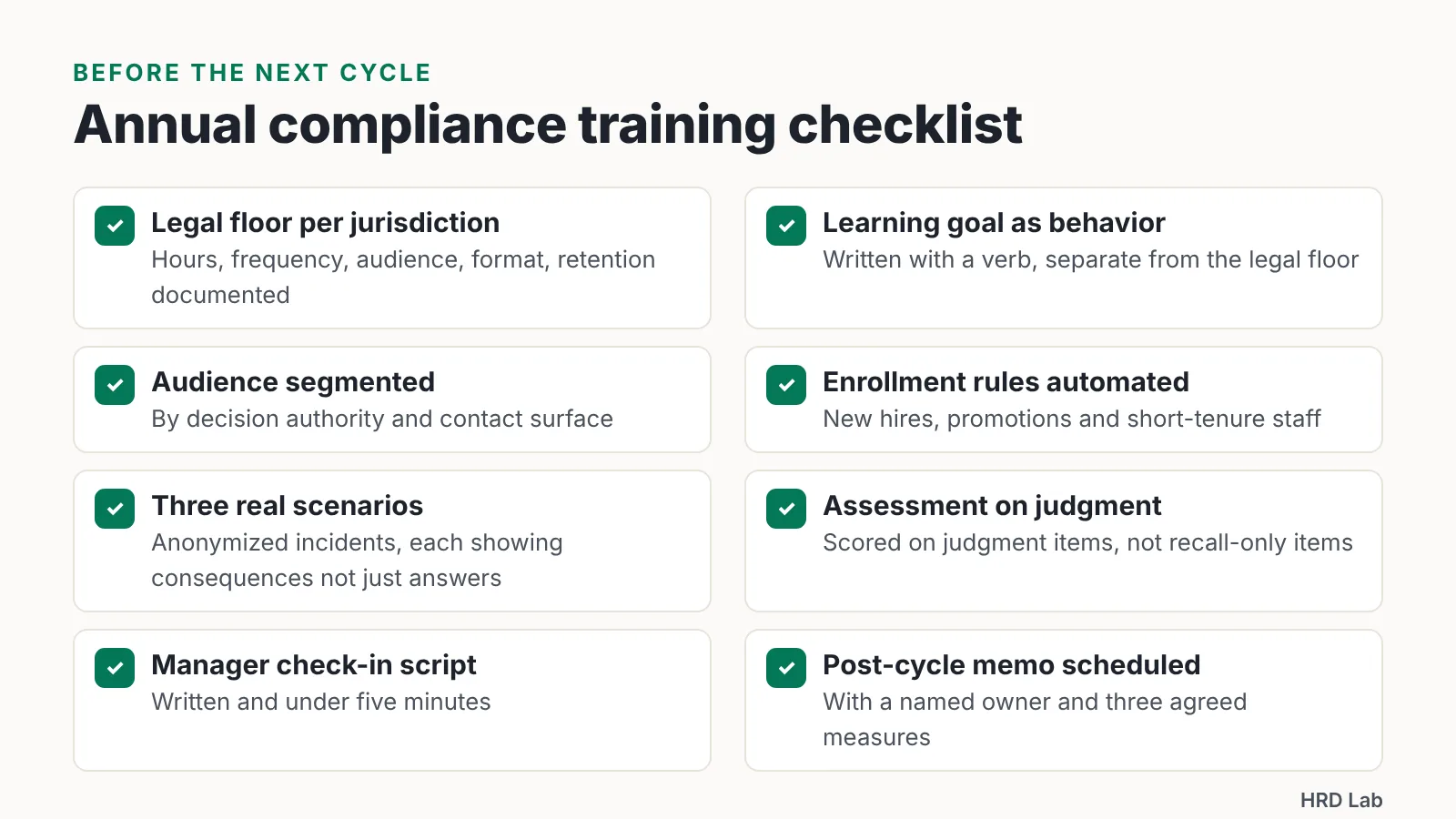
Your annual compliance training checklist (print this before the next cycle)
Run this before you renew a course license or open a design brief. Anything you cannot answer is a gap you will pay for later.
- [ ] Legal floor documented per jurisdiction: hours, frequency, audience, format, retention
- [ ] Learning goal written as a behavior with a verb, separate from the legal floor
- [ ] Audience segmented by decision authority and contact surface
- [ ] Enrollment rules automated for new hires, promotions and short-tenure staff
- [ ] At least three scenarios drawn from real anonymized incidents
- [ ] Every scenario shows consequences, not just a correct answer
- [ ] Assessment scored on judgment items, not recall-only items
- [ ] Manager check-in script written and under five minutes
- [ ] Records include name, date, training type, provider and completion evidence
- [ ] Refresher calendar mapped to risk moments across the year
- [ ] Three outcome measures agreed with legal and the business before launch
- [ ] Post-cycle memo scheduled, with a named owner
The checklist has twelve items and most teams fail on the same two: automated triggers and the manager conversation. Fix those before you spend money on new content.
Common mistakes that keep compliance training a tick-box exercise
The most expensive mistake is buying length to prove seriousness. A 90-minute module does not demonstrate commitment; it demonstrates that nobody edited it. Length should follow the statutory minimum and the decisions you need to cover, in that order.
Here is the failure to plan against specifically: the end-of-course quiz with unlimited retries and no question bank. Learners pass on attempt two by elimination, your completion report reads clean, and you have documented nothing about judgment.
Avoid it by scoring from a bank of scenario items, limiting retries to one per sitting, and reporting score distribution alongside completion.
Other patterns worth catching early:
- Translating the course but not the examples, so the scenarios make no sense in the local office
- Assigning the supervisor version to anyone with "lead" in their title, inflating hours for people with no hiring authority
- Launching every mandatory course in the same month, which guarantees click-through
- Treating the vendor’s default content as final without mapping it to your own incident history
Review the assignment logic annually. Roles change faster than course catalogs.
This article is general information about training design and does not constitute legal advice; confirm your obligations with qualified counsel in each jurisdiction where you employ people.
Frequently asked questions
How often does compliance training legally have to happen?
It depends entirely on jurisdiction and topic. California Legislative Information’s SB-1343 text set a baseline of at least one hour of sexual harassment training for all nonsupervisory employees by January 1, 2020, repeating once every 2 years thereafter, so "annual" is a company convention in that case, not the statutory floor.
Does "interactive" training mean it has to be live?
Not necessarily. The guidance in "California SB 1343: Training Hours, Deadlines, and Penalties" notes that California’s required harassment training must be interactive, with supervisors receiving at least two hours and all other employees at least one hour on a two-year cycle, which many employers satisfy through scenario-based e-learning that includes questions, branching choices and a route to ask a trainer follow-up questions.
What records should we keep after each cycle?
WILL Interactive notes that employers are expected to keep California harassment training records — name, date, training type, provider and completion evidence — for a minimum of 2 years. Add assessment scores and the date of the manager check-in so you can show judgment, not only attendance.
How do we handle seasonal and temporary staff?
Give them their own enrollment path rather than the annual cohort. Traliant reports that under California’s SB 1343, seasonal and temporary employees working less than six months must receive their one hour of training within 30 calendar days of hire or within 100 hours worked.
How short can a refresher module be and still be useful?
As a working rule, build refreshers around one decision and one action, which usually lands between two and four minutes. Refreshers sit between statutory cycles and do not replace them — Compliance Training Group notes that newly hired or newly promoted California supervisors must complete their two hours within six months of taking the role.
Sources
- Bill Text — SB-1343 Employers: sexual harassment training: requirements (California Legislative Information)
- California SB 1343: Training Hours, Deadlines, and Penalties
- California Sexual Harassment Training — Compliance Training Group
- California SB 1343 Sexual Harassment Training — Traliant
- California Sexual Harassment Training — SB 1343 Compliance (WILL Interactive)
AI tools helped write this guide. The HRD Lab Editorial Team published it after checking every figure against the sources linked above.