Drivers: ELDT before the CDL skills test, hazmat training by function, and hours-of-service refreshers that are practical rather than federally mandated.
What "DOT compliance training" actually covers, and who is on the hook
"DOT compliance training" is not one course. It is a stack of separate obligations written by different agencies under the Department of Transportation, and each rule names a different person as responsible. A regional truckload carrier answers to FMCSA. A municipal bus system answers to the Federal Transit Administration. Anyone loading regulated material answers to the hazmat rules in 49 CFR Part 172.
Four buckets cover most of what a mid-size fleet owes:
| Bucket | Typical audience | Where the rule lives |
|---|---|---|
| Entry and qualification training | New CDL drivers | FMCSA Entry-Level Driver Training rules |
| Drug and alcohol program training | All safety-sensitive employees; supervisors | 49 CFR Part 382, including §382.603 |
| Hazmat function-specific training | Loaders, handlers, shippers, some drivers | 49 CFR Part 172, subpart H |
| Operational refreshers | Drivers, dispatchers, driver managers | Hours of service in 49 CFR Part 395, securement, inspection |
The employer carries the recordkeeping burden in almost every case. A driver may hold the certificate, but an investigator asks you for the file. That distinction decides who gets fined.
Mode changes the math. For transit employers regulated by the Federal Transit Administration, the Federal Register notice on prevention of alcohol misuse and prohibited drug use in transit operations states that the minimum random drug testing rate remains 50 percent and the random alcohol testing rate remains 10 percent. Read your own agency’s rule text rather than borrowing a trucking checklist.
Dispatchers are the group most often left out. They schedule loads, take the 4 a.m. call, and see the driver first — yet many fleets never assign them a single DOT course.
Scenario: a 40-truck regional carrier whose dispatcher spots an impaired driver
Picture a 40-truck carrier running dry van freight between Columbus and Harrisburg. At 5:40 a.m., a dispatcher named Marisol hands a driver his load assignment and notices three things: slurred speech, a sweet chemical smell, and hands that won’t stay still. She has worked dispatch for six years. She has never taken a DOT course.
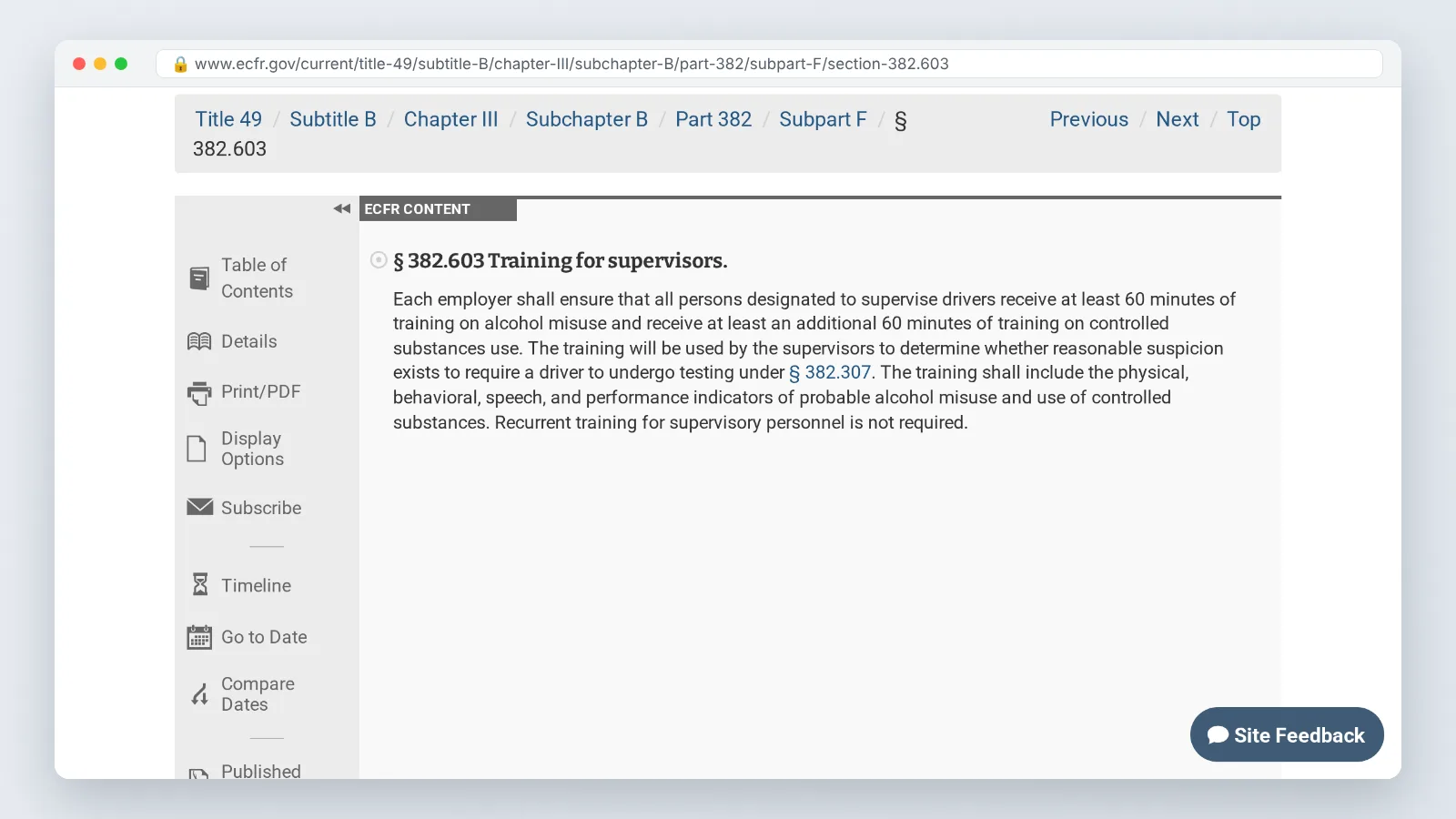
Her instinct is correct and her authority is not. According to the eCFR text of 49 CFR Part 382 on controlled substances and alcohol use and testing, reasonable-suspicion observations must be made by a supervisor or company official trained in accordance with §382.603, so an untrained dispatcher cannot lawfully trigger the test.
What happens next is the expensive part. Marisol calls the safety director, who is ninety minutes away and not answering. The driver waits in the break room. Two loads sit unassigned, and the observation window — the window where impairment is visible and documentable — closes.
The carrier can still pull the driver out of service on general fitness-for-duty grounds. That is a personnel action, not a DOT test, and it produces no testing record. If the driver later causes a crash, the file shows a gap where a reasonable-suspicion test should have been.
One trained person on every shift would have closed that gap. Not a program. One person, one course.
Driver-side requirements: ELDT, hazmat, HOS and what has to be retrained
Driver obligations split into a gate you pass once and cycles you repeat.
The gate is Entry-Level Driver Training. According to J. J. Keller’s guidance on FMCSA Entry-Level Driver Training, an entry-level driver must finish a prescribed program of theory and behind-the-wheel instruction delivered by a provider listed on FMCSA’s Training Provider Registry before taking the CDL skills test. Whether a particular upgrade or endorsement also sits inside that scope is a question for the regulation itself — verify it in the CFR rather than assuming the skills-test rule reaches every case.
Seat time alone does not satisfy it. According to DC DMV’s Entry-Level Driver Training page, the standard is performance-based: trainees must demonstrate proficiency in both behind-the-wheel instruction and the knowledge portions of the curriculum, not merely sit through hours.
After the gate, the repeating items:
- Hazmat — general awareness, function-specific, safety, security awareness and driver training for anyone performing a hazmat function, recurring on the cycle stated in 49 CFR 172.704. This article does not state the interval, because none of its sources verify it; read 172.704 directly before you build your calendar.
- Hours of service — no federal recurrent course is mandated for every driver, but Part 395 logging errors are a top roadside citation, which makes periodic refreshers a practical necessity rather than a legal one.
- Event-triggered retraining — after a preventable crash, a logging falsification, a securement failure, or a return-to-duty process, retrain on the specific failure and file the record.
- Carrier-specific onboarding — equipment, routes, customer site rules, winter operations. Not federally required, still the first thing a plaintiff’s attorney requests.
Write each item as a row with an owner and an expiry date. A certificate with no expiry field is a certificate nobody will renew.
Dispatcher and supervisor-side requirements: §382.603, Clearinghouse queries, HOS coaching
The supervisor course is the highest-leverage training in the whole program, and it is unusually cheap and unusually short. Section §382.603 governs training for anyone who designates drivers for reasonable-suspicion testing. According to Vertical Identity’s reasonable-suspicion training page covering 49 CFR §382.603, commercial courses built to that curriculum run two hours — read the section text for the content your own supervisors must cover.
Frequency surprises people. According to FMCSA regulatory guidance summarized by the J. J. Keller Compliance Network RegSense entry on §382.603 training for supervisors, employers are not required to provide recurrent refresher supervisor training, making it effectively a one-time course.
Treat "not required" as a floor, not a plan. Indicators get fuzzy after a few years, and your own insurer or shipper contract may demand a refresher cycle regardless.
Three obligations belong to the dispatch and supervisor side:
- §382.603 reasonable-suspicion training — assign it to every person who can order a driver out of service, including night dispatch and weekend coverage, not just the safety director.
- Clearinghouse query competence — whoever runs limited and full queries under Part 382 subpart G needs documented procedure training: consent handling, timing relative to hire, and what a positive return obliges you to do.
- Hours-of-service coaching — dispatchers who assign a load that cannot legally be run are manufacturing violations. Train them to read available hours before they build the plan.
The test for coverage is simple. Open your shift roster and mark every hour of the week where no §382.603-trained person is reachable within thirty minutes. Those are your exposure hours.
How often is "often"? One-time, fixed-cycle, event-triggered and continuous
Four frequency types explain nearly every DOT training question.
| Type | Examples | What triggers it |
|---|---|---|
| One-time | ELDT before the CDL skills test; §382.603 supervisor course | Role entry |
| Fixed-cycle | Hazmat recurrent training under 49 CFR 172.704 | Calendar date in the CFR |
| Event-triggered | Post-accident review, return-to-duty follow-up, violation retraining | An incident |
| Continuous | Random testing pool management, Clearinghouse queries | Rolling program operation |
| Continuous, FTA transit employers | Random pool held at the FTA minimums — 50% drug and 10% alcohol, per the Federal Register transit notice | Rolling program operation |
The continuous bucket is where fleets drift. According to Overdrive’s report on the DOT 2026 random drug and alcohol testing rates, the FMCSA minimum random drug testing rate stays at 50% of the average driver pool for calendar year 2026 and the random alcohol testing rate stays at 10%.
A workable 12-month rhythm for a regional carrier: January, confirm pool size and selection schedule; February, run annual Clearinghouse limited queries on the CDL roster; April, hazmat recurrent cohort; July, hours-of-service refresher tied to your mid-year citation data; October, verify §382.603 coverage against the current supervisor and dispatcher roster; December, close out expiring certificates before the new plan year.
Spread testing selections across all four quarters. Bunching them into December is the pattern investigators notice first.
Before and after: spreadsheet-and-email tracking vs. an assigned, auto-expiring workflow
Return to the 40-truck carrier. The figures below are that scenario’s own numbers, used to show the shape of the change — not survey findings.
| Item — illustrative scenario, not measured data | Before: spreadsheet and email | After: assigned LMS workflow |
|---|---|---|
| §382.603-trained staff | 2 (safety director, operations manager) | 9 (adds 5 dispatchers, 2 shop leads) |
| Hours per week with no trained official reachable | 61 | 0 |
| Where certificates live | Three inboxes and a shared drive folder | One record per person, with expiry dates |
| Expiry alerts | None; discovered at renewal or audit | Automatic, 60 days out, to employee and manager |
| Time to assemble an audit packet | Most of a working day | Minutes, filtered by rule and date |
The mechanism matters more than the software. An assignment rule says this role gets this course within this many days of hire, and an expiry rule says this certificate dies on this date and reassigns itself. A spreadsheet can hold both facts and will never act on them.
One caution: migrating old certificates is the real work. Scan what exists, identify what is missing, and schedule the gaps before you switch systems.
Reproducible procedure: build your DOT training matrix in five steps
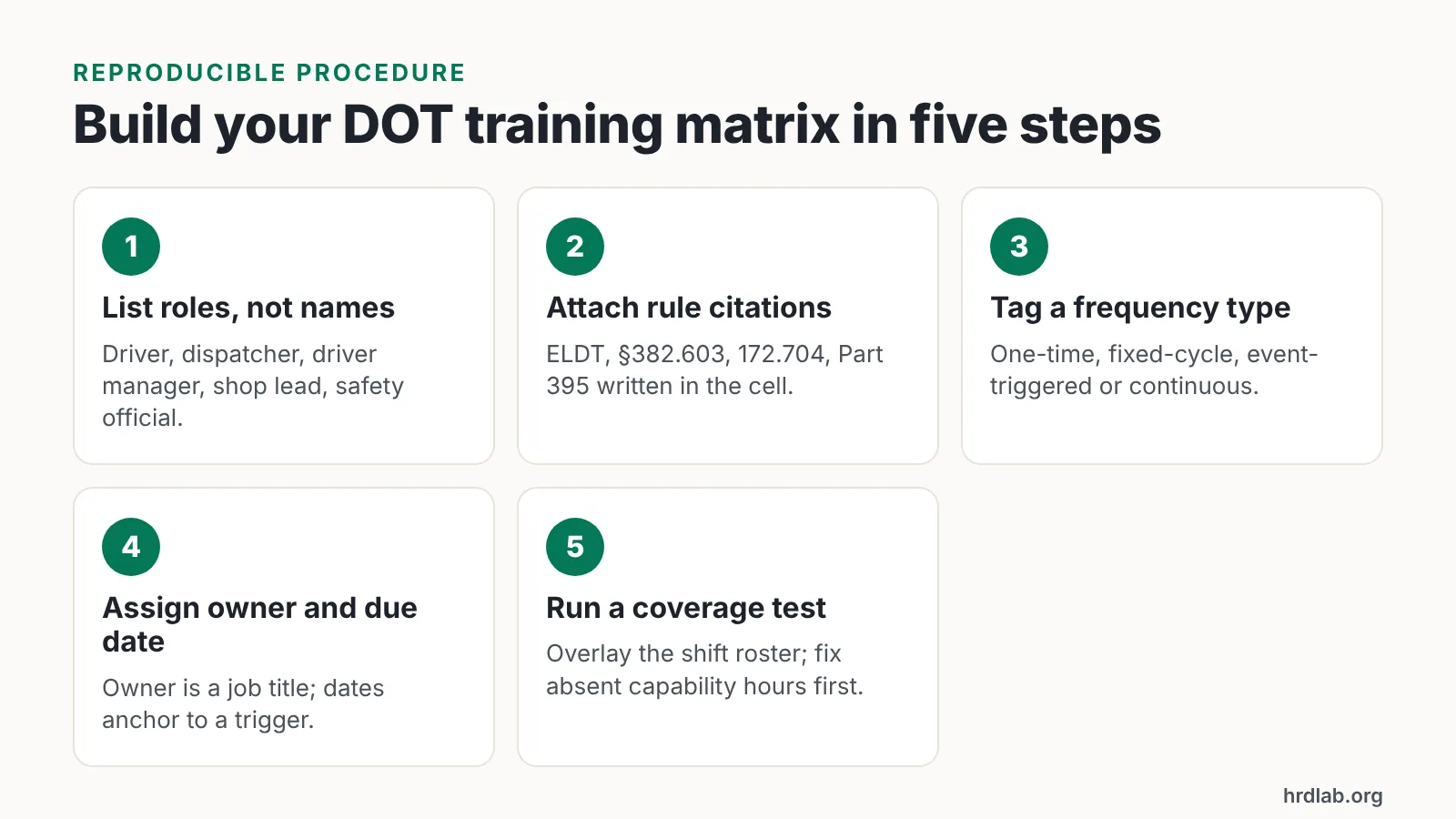
Step 1 — List roles, not names. Driver, hazmat-endorsed driver, dispatcher, driver manager, shop lead, safety official. People move between roles; the matrix should survive turnover.
Step 2 — Attach rule citations to each role. Write the actual section number in the cell: ELDT rules for new CDL applicants, §382.603 for anyone designating tests, 172.704 for hazmat functions, Part 395 for anyone building or running a schedule. A matrix without citations cannot be defended.
Step 3 — Tag each cell with a frequency type. One-time, fixed-cycle, event-triggered, or continuous. This single column answers most "do we need to redo this?" emails.
Step 4 — Assign an owner and a due date per cell. The owner is a job title inside your company, not a vendor. Due dates anchor to a trigger: hire date, endorsement date, or last completion date.
Step 5 — Run a coverage test against the shift roster. Overlay the roster on the matrix and find the hours where a required capability is absent. Fix those first, then build the rest of the calendar.
Redo steps 4 and 5 every quarter. Fleets add night shifts and lose supervisors faster than they update training plans.
Budget, proof and audit-ready records: cost per seat and what an investigator asks for
Supervisor training is inexpensive relative to a single violation. According to Vertical Identity’s reasonable-suspicion training page covering 49 CFR §382.603, commercial courses that deliver the required two-hour curriculum are sold at around $55 per seat. Training nine people at that figure costs less than one deadheaded truck.
Random testing is the recurring cost, and it is predictable. According to Trucksafe Consulting, the current FMCSA random testing rates have now held for six consecutive years, after the agency raised the random drug testing rate from 25% in January 2020.
What a compliance investigator typically requests:
- Driver qualification files with ELDT documentation for applicable drivers
- Proof of §382.603 training for every official who designated a reasonable-suspicion test
- Random selection lists, test results, and the method used to select
- Clearinghouse query records tied to hire dates
- Hazmat training records naming the function trained and the date completed
Every record needs four fields: who, what rule, what date, and who certified it. A certificate without a rule citation forces the investigator to guess, and guessing never favors the carrier.
Store records where a replacement safety director can find them in a week. Institutional memory is not a compliance control.
This article is general information about US federal transportation rules, not legal advice; confirm current requirements with the CFR text or counsel before changing your program.
Frequently asked questions
Can a dispatcher order a reasonable-suspicion drug test?
Only if that dispatcher completed §382.603 training. According to the eCFR text of 49 CFR Part 382, reasonable-suspicion observations must be made by a supervisor or company official trained in accordance with §382.603, so an untrained dispatcher cannot lawfully trigger the test even with clear observations.
Does §382.603 supervisor training have to be repeated every year?
No federal refresher is mandated. According to FMCSA regulatory guidance summarized by the J. J. Keller Compliance Network RegSense entry, employers are not required to provide recurrent supervisor training under §382.603, making it effectively a one-time course — though insurers and shipper contracts sometimes require more.
What are the 2026 random drug and alcohol testing rates for motor carriers?
According to Overdrive’s report on the DOT 2026 random testing rates, the FMCSA minimum random drug testing rate stays at 50% of the average driver pool and the random alcohol testing rate stays at 10% for calendar year 2026.
Is ELDT satisfied by completing a set number of training hours?
No. According to DC DMV’s Entry-Level Driver Training page, the standard is performance-based: trainees must demonstrate proficiency in both behind-the-wheel instruction and the knowledge portions of the curriculum, not merely accumulate hours in a classroom or cab.
How much should we budget for supervisor reasonable-suspicion training?
According to Vertical Identity’s §382.603 training page, commercial courses delivering the required two-hour curriculum are sold at around $55 per seat. Budget for every person who can designate a test, including night dispatchers and weekend shop leads, not only the safety director.
Sources
- §382.603 Training for supervisors – J. J. Keller Compliance Network (RegSense)
- eCFR :: 49 CFR Part 382 — Controlled Substances and Alcohol Use and Testing
- DOT announces 2026 random drug, alcohol testing rates – Overdrive
- FMCSA Keeps Random Drug & Alcohol Testing Rates the Same for 2026 – Trucksafe Consulting
- Prevention of Alcohol Misuse and Prohibited Drug Use in Transit Operations – Federal Register (FTA notice)
- Entry-Level Driver Training – DC DMV
- FMCSA Entry-Level Driver Training – J. J. Keller
- Reasonable Suspicion Training — 49 CFR § 382.603 – Vertical Identity
AI tools helped write this guide. The HRD Lab Editorial Team published it after checking every figure against the sources linked above.