Clinics deliver compliance training across shifts by splitting it in two: asynchronous core modules each person completes on paid time, plus 10-minute drills run at every handover huddle, with one record template and a named owner per site.
The scenario: three sites, 90 staff, and no shared room
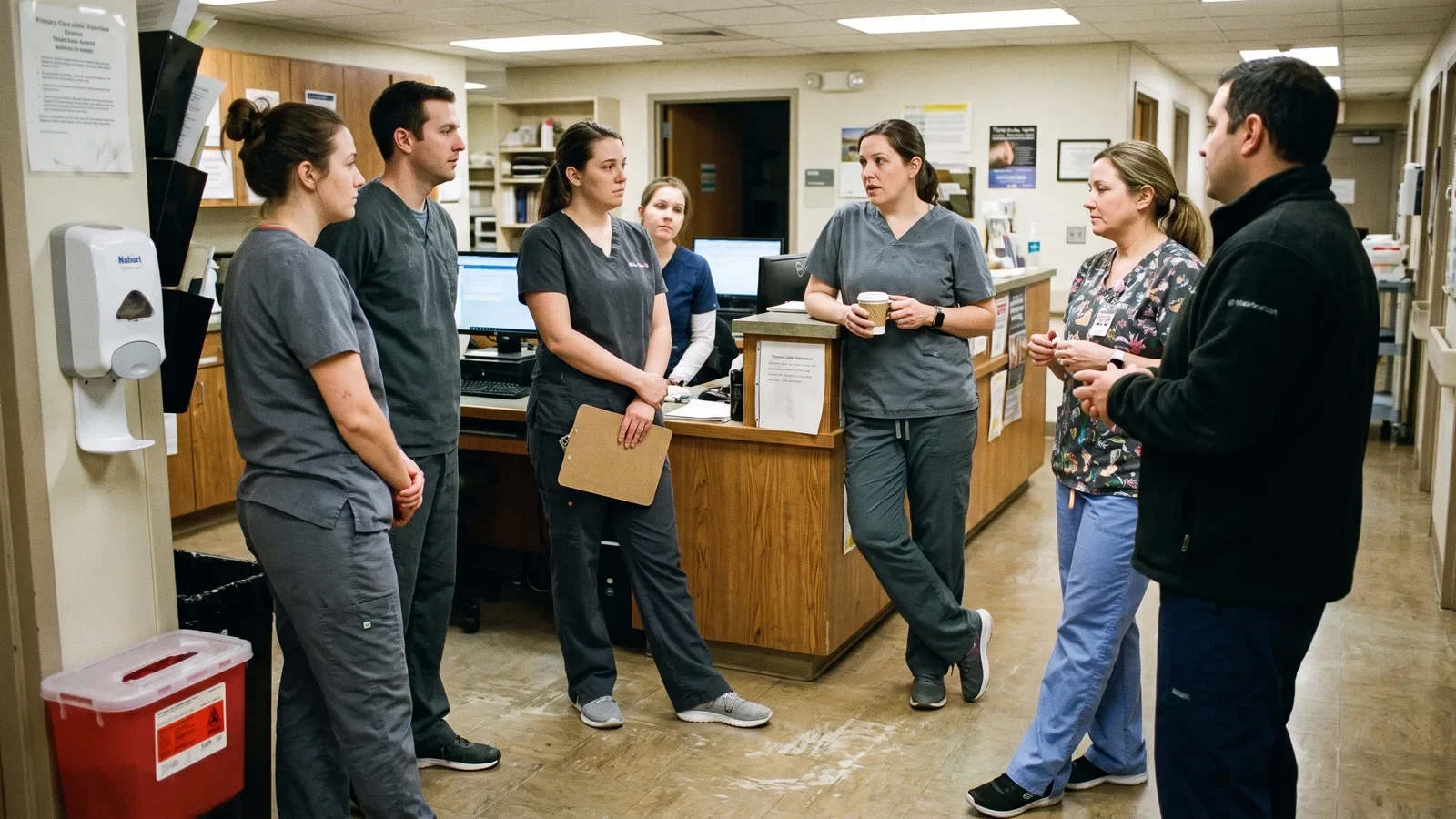
Picture Northline Primary Care. It is a composite example built for this article, not a client case study: three clinics in one metro area, 90 people on the payroll, and no hour of the week when all of them are on site together.
The day shift runs 7:00 to 15:30 at all three locations. The main site keeps an extended-hours and telehealth team until 23:00, the north site runs a Saturday and Sunday urgent-care rotation, and a float pool of medical assistants plugs gaps wherever the schedule breaks.
Add the edges. Two per diem phlebotomists, three traveler RNs on 13-week contracts, a contracted after-hours cleaning crew that handles exam rooms and sharps areas, and a billing team that works remotely three days a week.
Every clinical role has occupational exposure to blood or other potentially infectious material. Every role, including front desk and billing, touches protected health information. The compliance surface is the whole roster, not the clinical half of it.
The practice manager owns training on top of scheduling, credentialing and payroll. That single detail explains most of what goes wrong next.
What the rules demand of a multi-shift clinic
Two federal frameworks apply to a US primary care group like this one: the HIPAA rules enforced by the HHS Office for Civil Rights, which cover the clinic as a covered entity and its whole workforce, and OSHA’s bloodborne pathogens standard, which covers employees with occupational exposure. They are not the same shape.
According to OSHA, the bloodborne pathogens standard requires employers to train employees with occupational exposure at initial assignment and at least annually thereafter, with each annual session falling within one year of the previous one. That is a per-person clock, not a calendar-year box to tick.
HIPAA runs differently. The Privacy Rule requires training for workforce members on the policies and procedures that apply to their functions, and for retraining when those policies materially change, but it does not impose OSHA’s one-year interval.
| OSHA bloodborne pathogens | HIPAA workforce training | |
|---|---|---|
| Who it covers | Employees with occupational exposure | All workforce members, clinical and non-clinical |
| Clock | Initial assignment, then at least annually within one year of the last session | No fixed federal interval; triggered by role and material policy change |
| Paid time | Required at no cost, during working hours | Not specified in the rule |
| Record retention | 3 years from the training date | 6 years from creation or last effective date |
Two more dates belong on your planning wall. The HIPAA Journal reports that the HHS Office for Civil Rights published its proposed overhaul of the HIPAA Security Rule in the Federal Register on January 6, 2025, and that the final version has slipped on the federal regulatory agenda to July 2027. Treat the proposal as direction of travel for now. State OSHA plans and state privacy laws can be stricter than the federal floor, so check yours before you lock the calendar.
Before: the Tuesday lunchtime in-service
The old model at Northline was one live session: Tuesday, 12:15, main-site break room, sandwiches provided. Annual bloodborne pathogens content in March, HIPAA refresher in September, sign-in sheet passed around the table.
In the illustrative scenario, 58 of the 90 staff attended the March session. The other 32 were the evening team asleep at noon, the weekend rotation, two per diem phlebotomists not scheduled that day, float MAs covering the south site, and the cleaning contractor who never sees a daytime manager.
Makeups happened by email. "Watch the recording at home and reply when you’re done" is the line that quietly breaks the rule — Cornell’s Legal Information Institute summary of 29 CFR 1910.1030 notes that bloodborne pathogens training must be provided at no cost to the employee and during working hours, which means paid shift time, not a laptop on a kitchen table.
The records were worse than the attendance. A photocopied sign-in sheet carries names, sometimes job titles, and nothing about the trainer’s qualifications or the session contents.
Annual anchors drifted too. When the March session slid to late April one year, every person tied to it started the next cycle outside the one-year window.
After: the shift-agnostic model
The fix is structural, not motivational. Split the program into a layer that does not care what time it is, and a layer that happens at every single shift change.
Layer one is the asynchronous core: annual bloodborne pathogens training, HIPAA privacy and security basics, the exposure control plan walkthrough, and role-specific modules for front desk, billing and lab. Keep each module short enough to finish inside a gap between patients — under 12 minutes is a workable ceiling.
Layer two is the huddle drill. Ten minutes at the 7:00, 15:00 and Saturday 8:00 handovers, same topic for the month, run by whichever lead is on. One month covers sharps disposal after a needlestick; the next covers what to do when a patient’s relative asks for records at the front desk.
Production has to be cheap or it will not survive the second quarter. Clinics that already keep their exposure control plan as a slide deck can convert it into narrated video rather than rebuilding from scratch — AI Studios accepts .ppt, .pptx, .pdf, .doc, .docx, .xlsx and .txt files up to 20 MB in its Docs to Video flow, and its Enterprise plan adds SCORM export for your LMS, per its pricing page.
Both layers sit inside paid time. Schedule the asynchronous blocks like you schedule a patient slot, and record the drill as part of the shift.
The reproducible procedure: a 12-month cross-shift calendar in nine steps
Nine steps, in order:
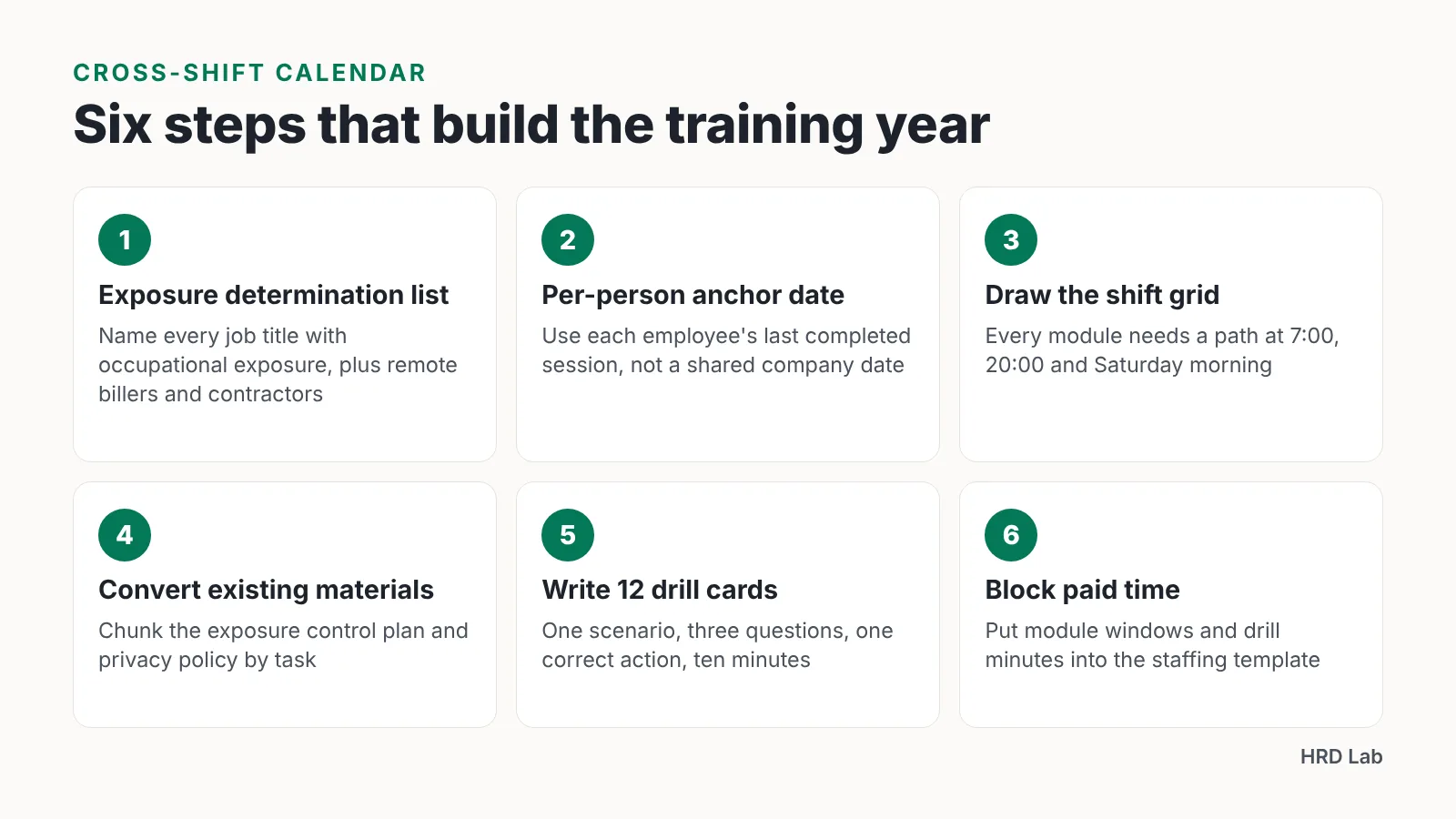
- Build the exposure determination list. Name every job title with occupational exposure, then list every workforce member for the HIPAA side, including remote billers and contractors with system access.
- Set a per-person annual anchor date for bloodborne pathogens. Use each employee’s last completed session, not a shared company date, so the one-year interval holds individually.
- Draw the shift grid. Every module needs a delivery path that works at 7:00, at 20:00 and on Saturday morning.
- Convert existing materials into short modules. Your exposure control plan, sharps protocol and privacy policy are already written; chunk them by task, not by chapter.
- Write 12 huddle drill cards, one per month. Each card: one scenario, three questions, one correct action, ten minutes.
- Block paid time on the schedule. Put module windows and drill minutes into the staffing template before the month opens.
- Create the record template with the required OSHA fields before the first session runs, not after.
- Assign a named owner per site plus one backup. Weekend and evening need their own owner, or the gap reappears.
- Define the exception path. Who gets chased on day 7, who escalates on day 14, what happens to system access on day 30.
Run steps 1 through 5 once. Steps 6 through 9 repeat every quarter.
Proving it happened: record fields, retention clocks and folder structure
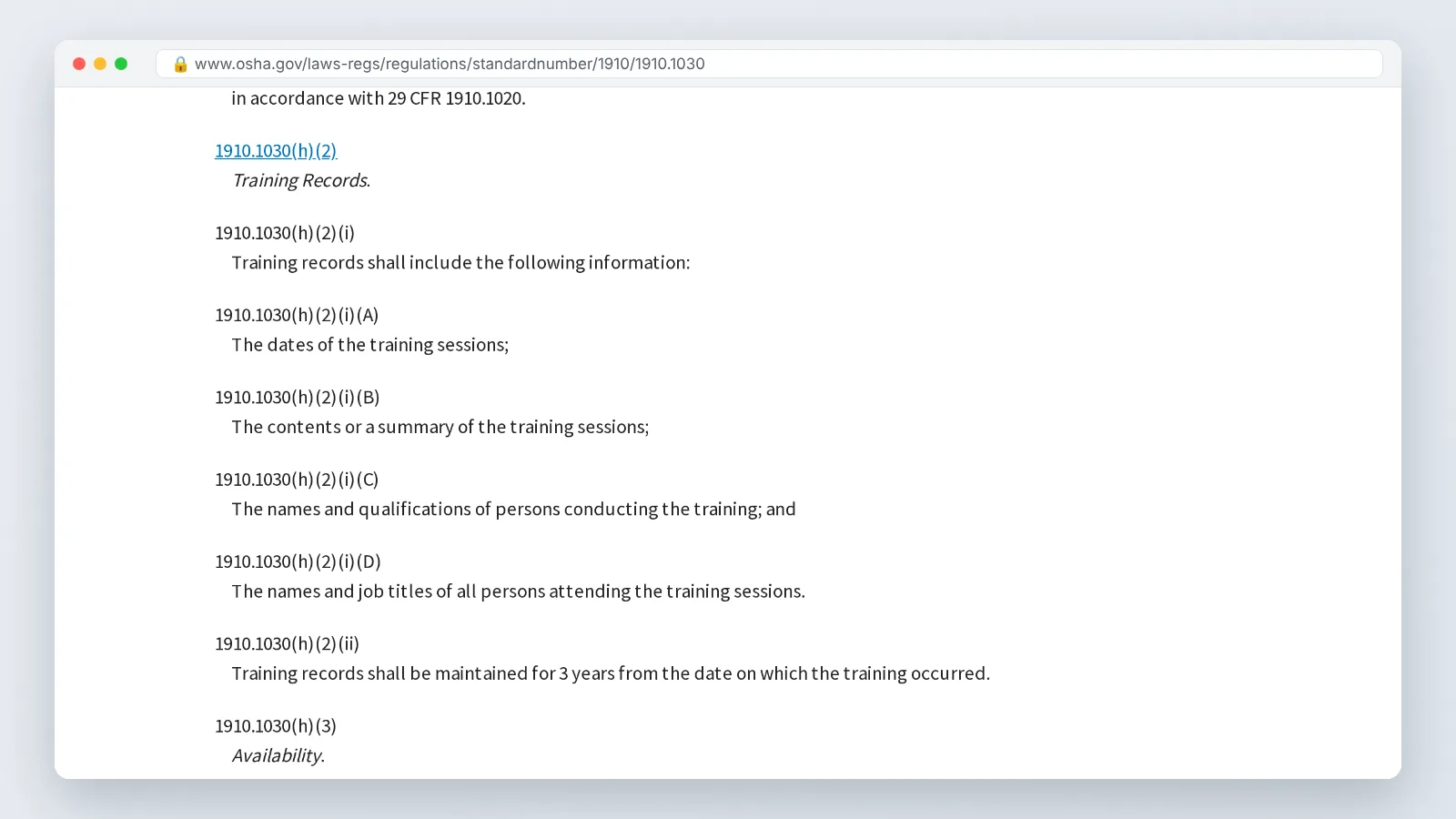
An inspector does not grade your intentions. OSHA specifies exactly what a bloodborne pathogens training record must contain: the dates of the sessions, the contents or a summary, the names and qualifications of the trainers, and the names and job titles of everyone who attended.
Copy those four fields into your template verbatim and add two of your own: shift cohort and delivery mode. Those two extra columns are what let you answer "how did the night team do?" without re-reading the whole log.
Retention clocks differ sharply, so set folders by clock, not by year:
| Record type | Retention period |
|---|---|
| OSHA bloodborne pathogens training records | 3 years from the date the training occurred |
| Employee medical records under the same standard | Duration of employment plus 30 years |
| HIPAA required documentation, including training documentation | 6 years from creation or from the date last in effect, whichever is later |
According to OSHA, bloodborne pathogens training records must be retained for 3 years from the date the training occurred, while employee medical records under that standard carry a far longer clock of duration of employment plus 30 years. The eCFR text of 45 CFR 164.530 requires covered entities to retain required documentation, including training documentation, for six years from creation or from the date it was last in effect, whichever is later.
Keep hepatitis B vaccination and post-exposure records out of the training folder entirely. They are medical records, with the longest clock and the tightest access limits.
Onboarding and churn: a 30-day access-and-training gate
New hires, travelers and per diem staff are where multi-shift programs leak. A traveler RN who starts on a Sunday will not meet a training owner until Monday week unless the gate is automated.
Build a day-one gate instead of a week-one reminder. Badge activation and EHR account creation both wait on two completions: the bloodborne pathogens module at initial assignment, and the HIPAA privacy basics module.
The proposed Security Rule would require regulated entities to train new workforce members on security requirements within 30 days of granting them access to relevant electronic information systems, as summarized by law firm Davis Wright Tremaine. The HIPAA Journal reports that the final rule has slipped to July 2027 on the federal regulatory agenda, so adopt the 30-day gate as practice design rather than as a current legal deadline.
Contractors need a different path. For the cleaning crew and agency staff, collect a written attestation from the agency plus your own site-specific session on sharps containers, spill response and which areas they may enter.
Offboarding matters too. When a traveler’s contract ends, the access revocation ticket and the training record archive should fire from the same checklist.
Measuring the program: completion by shift and what to fix in quarter two
Clinic-wide completion percentages hide the exact problem you are trying to solve. Report completion by shift cohort — day, evening, weekend, float, per diem, contractor — and the evening gap becomes visible in week two instead of month eleven.
Four numbers to pull monthly: completion rate per cohort, days from hire to first module completion, huddle drill attendance per handover, and open exceptions older than 14 days. All four are counts you generate, not benchmarks you borrow.
Run an exception register rather than a chase list. Each row names the person, the missed module, the reason, the new date and the owner, which turns a vague backlog into nine specific conversations.
In the illustrative Northline scenario, the before-state left 32 of 90 staff outside the live March session; the shift-agnostic model targets all 90 inside the quarter window, with every bloodborne pathogens anchor date tracked per person.
Quarter two is for pruning. Cut any module where completion stalls past the halfway mark, shorten drill cards that consistently run over ten minutes, and re-record anything that referenced a policy you have since changed.
This article is general information for L&D and HR teams, not legal advice; confirm your obligations with counsel and your state OSHA plan.
Frequently asked questions
How often does OSHA require bloodborne pathogens training for clinic staff?
OSHA requires employers to train employees with occupational exposure at initial assignment and at least annually thereafter, with each annual session falling within one year of the previous one. Track that interval per person, because a slipped group session pushes everyone tied to it out of window.
Can night and weekend staff complete compliance training at home?
Not for bloodborne pathogens. Cornell’s Legal Information Institute summary of 29 CFR 1910.1030 notes training must be provided at no cost to the employee and during working hours, so clinics need paid shift-time windows for evening, weekend and per diem staff rather than homework assignments.
How long do we keep healthcare compliance training records?
OSHA requires bloodborne pathogens training records to be kept for 3 years from the training date, while 45 CFR 164.530 requires HIPAA documentation, including training documentation, to be kept for six years from creation or last effective date, whichever is later.
What has to appear on a training record for an OSHA inspection?
OSHA specifies the dates of the sessions, the contents or a summary of them, the names and qualifications of the trainers, and the names and job titles of all attendees. Add shift cohort and delivery mode so you can audit coverage by rotation.
Should we build training around the proposed HIPAA Security Rule changes now?
Design for it, don’t panic about it. The HIPAA Journal reports the proposal was published on January 6, 2025 and the final rule has slipped to July 2027, and Davis Wright Tremaine notes it would require training new workforce members within 30 days of system access.
Sources
- 1910.1030 – Bloodborne pathogens. | Occupational Safety and Health Administration
- 29 CFR § 1910.1030 – Bloodborne pathogens | Cornell Law School LII
- eCFR :: 45 CFR 164.530 — Administrative requirements
- The Impact of Proposed Changes to the HIPAA Security Rule for Business Associates | The HIPAA Journal
- HIPAA Security Rule Resolves To Hit the Gym and Bulk Up | Davis Wright Tremaine
AI tools helped write this guide. The HRD Lab Editorial Team published it after checking every figure against the sources linked above.