Employee morale training in practice is team-lead training: a six-week cycle with a baseline pulse in week 1, five skill blocks across weeks 2–5 (noticing and coaching paired in week 2, then recognition, workload triage, escalation), and a manager scorecard plus re-pulse in week 6.
Quick steps
- Pulse before you schedule. Run a short anonymous survey on the affected team in week 1, using the exact questions you plan to repeat in week 6.
- Train the lead, not the whole team. The person who sets the weekly rhythm is the person whose habits have to change.
- Teach the five skill blocks across weeks 2–5 — two in the first practice week, one a week after that — and require the lead to use each one on a named team member within 48 hours.
- Rebuild the lead’s calendar so coaching conversations and workload triage sit in fixed slots instead of leftover gaps.
- Score behavior, not completion — then re-pulse the same team six weeks after the baseline and compare question by question.
Everything below is written for one team with one lead, because that is the smallest unit where morale actually moves. Scaling to twelve leads is the same procedure run twelve times, with a shared scorecard. Read the steps in order; the baseline pulse loses most of its value if you run it after the first workshop.
Why employee morale training is really team-lead training
Morale results usually get read as a verdict on the team. The lever sits one level up. According to Inc., managers account for 70 percent of the variance in team engagement, which is why morale training is usually targeted at team leads rather than whole teams.
Gallup reports that in 2024 manager engagement fell from 30% to 27% globally while individual contributor engagement stayed flat at 18%. Read that as a diagnosis, not trivia. The layer you are asking to lift morale is the layer losing it fastest.
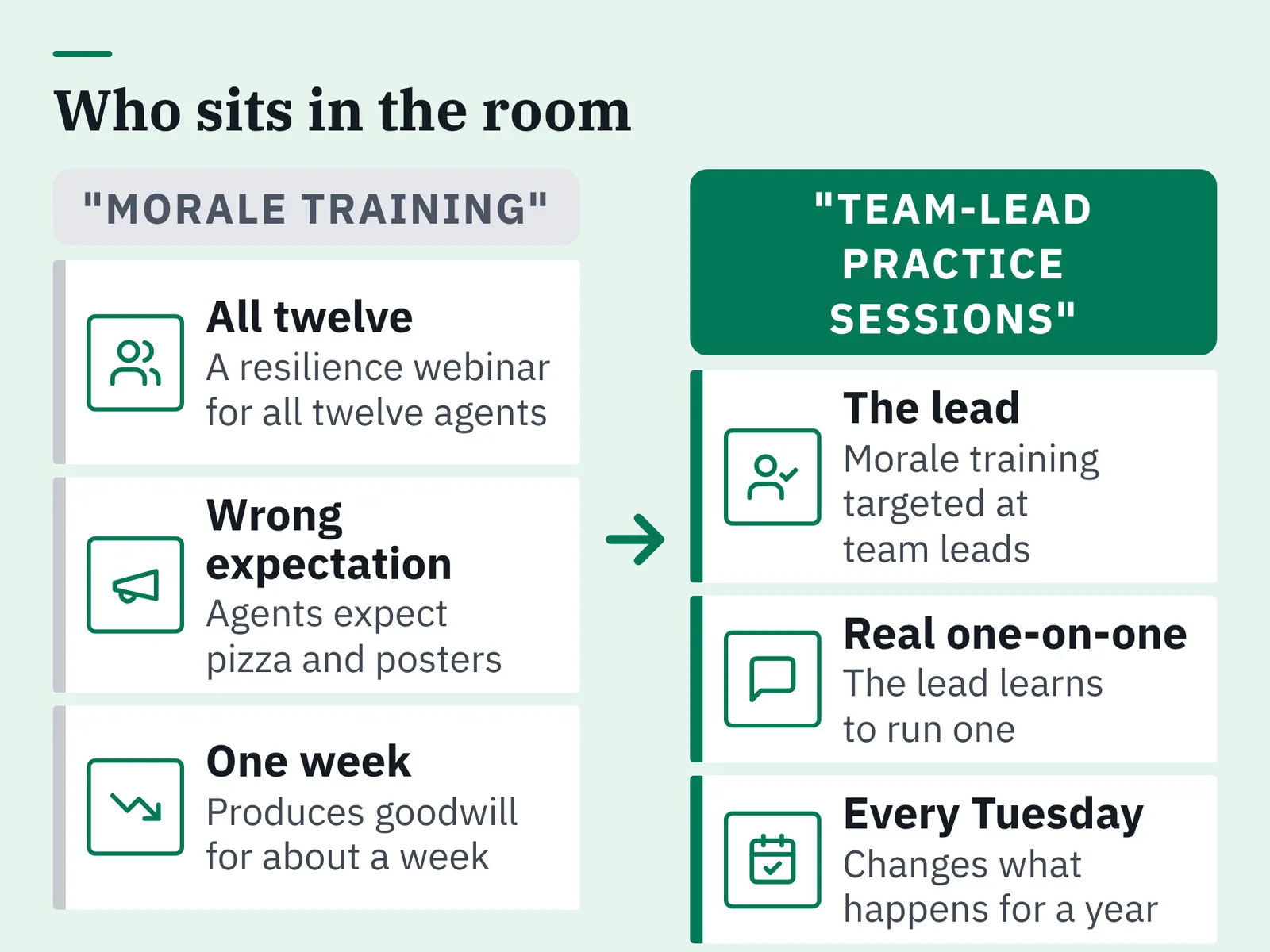
Practically, this changes who sits in the room. A resilience webinar for all twelve agents produces goodwill for a week; a lead who learns to run a real one-on-one changes what happens every Tuesday for a year. Budget accordingly.
It also changes what you call the program internally. "Morale training" invites agents to expect pizza and posters, while "team-lead practice sessions" sets the right expectation for the lead. Pair it with the same groundwork you would cover in our guide to employee relations training for new managers, so the lead knows where coaching stops and HR begins.
The scenario: a 12-person support team, falling eNPS and a first-time lead
Example (illustrative, not a case study): a 12-person customer support team at a mid-sized software company. The lead was promoted out of the queue four months ago and still carries a partial ticket load. Two quarters of declining eNPS, unplanned absence creeping up on Mondays, and one resignation citing "no idea where I stand."
The symptoms cluster in a recognisable way:
- Tickets are allocated by whoever shouts loudest in chat.
- One-on-ones are booked monthly and cancelled when volume spikes.
- Praise happens in a group channel, generically, after big incidents only.
- The lead’s own manager reviews queue metrics, never team health.
Context matters here. Gallup reports that global employee wellbeing declined for a second consecutive year in 2024, with only 33% of employees rating their lives positively — so a support team arriving at work already depleted is not unusual.
The lead is not a bad manager. The lead has no model for the job and no protected time to do it. Morale-focused training exists to supply both.
Before: one week in the life of a morale-blind team lead
Monday starts with the weekend backlog. The lead clears tickets until noon, cancels the 1:1 with the newest agent, and posts a "great push everyone" message at 6pm.
Tuesday is escalations. An agent mentions being swamped in a hallway comment; the lead says "hang in there" and means it. No note is made, no reallocation happens.
Wednesday brings a sick call. The lead reshuffles the rota by instinct, loading the two people who never complain. Those two are the ones most likely to resign.
Thursday is reporting day. The lead assembles handle-time and CSAT figures for their own manager, who asks about the queue and not about the people in it.
Friday is catch-up. The monthly 1:1 that does happen runs eighteen minutes, covers ticket volume, and ends with "anything else?" — a question nobody answers honestly in the last two minutes of a Friday.
Nothing in that week is negligent. The week simply contains no mechanism for noticing, naming or fixing morale, and the data the lead reports upward cannot detect the problem either.
What morale-focused training for team leads actually covers: five skill blocks
Five blocks delivered across weeks 2–5 — noticing and coaching paired in the first practice week, one block a week after that — each rehearsed on a real team member rather than a case study:
- Noticing and naming. Reading signals — withdrawal from chat, absence patterns, quality drift — and saying what you see without diagnosing the person.
- The weekly coaching conversation. A 25-minute structure: what’s working, what’s blocked, what you need from me, one commitment each.
- Recognition that lands. Specific, timely, and matched to preference — some people want the channel post, some want the quiet message.
- Workload triage and queue fairness. Reallocating tickets by a visible rule instead of by who complains, and saying no upward with evidence.
- Escalation and boundaries. Knowing which conversations belong to HR, occupational health or the lead’s own manager, and handing them over cleanly.
One caution on block 5: which conversations must leave the lead’s desk, and who they go to, depends on local employment law and your own internal policy, so confirm both before you write the handover list.
Who needs this most is not random. Gallup reports that managers under 35 lost five percentage points of engagement in 2024 and female managers lost seven, identifying the two groups most in need of morale-focused support.
Each block needs a rehearsal, not a slide. Role-play the awkward version — the agent who says "I’m fine" — and debrief the lead on what they missed.
The 6-week rollout: baseline pulse to manager scorecard
| Week | What happens | Output |
|---|---|---|
| 1 | Baseline pulse (6 questions), lead interview, calendar audit | Baseline scores + current time allocation |
| 2 | Block 1 noticing + block 2 coaching conversation; 1:1s booked weekly | 12 recurring 1:1 slots in the calendar |
| 3 | Block 3 recognition; lead sends three specific recognitions | Recognition log started |
| 4 | Block 4 workload triage; allocation rule written and published to team | Written queue rule |
| 5 | Block 5 escalation; HR partner joins the session | Agreed handover list |
| 6 | Re-pulse, lead debrief, manager scorecard agreed with the lead’s own manager | Scorecard + next-quarter cadence |
Keep the sessions short and the fieldwork heavy — 90 minutes of practice, then the rest of the week applying it. The scheduling, reminders and completion tracking belong in whatever system already handles employee training management, not in a spreadsheet the L&D manager maintains by hand.
One rule protects the whole rollout: the lead’s own manager attends weeks 1 and 6. Without that, the scorecard has no owner after you leave.
After: the same week, rebuilt around coaching, recognition and triage
| Before | After week 6 | |
|---|---|---|
| 1:1s | Monthly, cancelled when busy | Weekly, 25 minutes, protected |
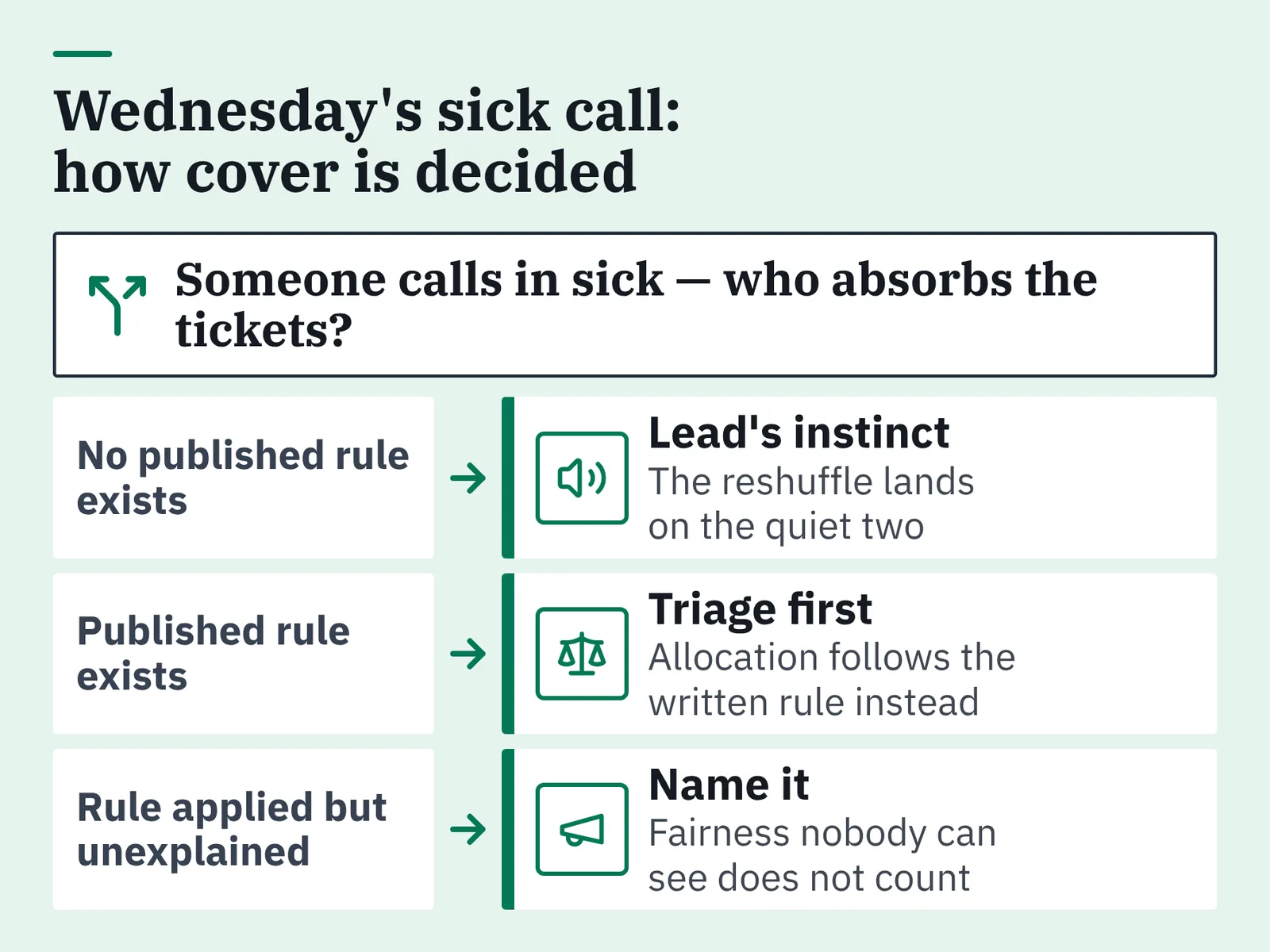
| Ticket allocation | Loudest voice, lead’s instinct | Published rule, reviewed Wednesdays |
| Recognition | Generic, post-incident only | Named and specific, logged weekly |
| Upward reporting | Queue metrics only | Queue metrics + team health note |
| Sick-day response | Reshuffle onto the quiet two | Triage against the written rule |
Monday now opens with fifteen minutes of signal review before the backlog: who was quiet last week, who worked two late shifts, who has a 1:1 today. Tickets still arrive. The lead simply reads the team before reading the queue.
Wednesday’s sick call triggers the written rule rather than instinct, and the lead tells the team which rule was applied. Fairness that nobody can see does not count.
Friday’s 1:1 ends with one commitment from each side, written down. That single artifact is what makes the next conversation possible.
Measuring the morale lift: metrics, cadence and realistic benchmarks
Track four things, on three different clocks:
- Weekly: 1:1 completion rate, recognitions logged, triage rule applications.
- Monthly: unplanned absence, voluntary attrition, internal transfer requests.
- Quarterly: eNPS and the six baseline pulse questions, worded identically each time.
- Each cycle: the manager scorecard — behaviors observed, not courses completed.
The scorecard itself is short enough to fit on one page:
| Observed behavior | What "met" looks like |
|---|---|
| Weekly 1:1 held with each team member | Held and logged, not rescheduled into next week |
| Specific recognition given | Named person, named behavior, entered in the recognition log |
| Triage rule applied to reallocations | Cover decided by the published rule, including on sick days |
| Signals noticed and named | Withdrawal, absence or quality drift raised with the person directly |
| Escalation handled cleanly | Out-of-scope issues handed to HR or the lead’s manager, with the team member told what happens next |
Expect behavior metrics to move first and sentiment metrics to lag. A lead can hold twelve 1:1s in week two; the team’s trust that those 1:1s will keep happening takes a quarter.
There is an upper bound worth aiming at. Talkspirit, summarising Gallup’s 2024 study, reports that in organisations Gallup classes as best-practice for manager development and wellbeing investment, three-fourths of managers and 7 in 10 non-managers are engaged.
The cost of ignoring the measurement is documented too. Gallup estimates that global employee engagement fell by two percentage points in 2024, a drop it values at $438 billion in lost productivity worldwide. If your pulse cadence is annual, you will find out about your own version of that number eleven months late. Automating the reminder and collection side is one of the few places where AI tools for HR teams earn their keep.
Where morale training fails — and the fixes to build in before launch
Five failure modes, each with a fix you install before week 1:
- Training the team instead of the lead. Fix: the only required attendee is the lead; the team gets a 10-minute briefing on what will change.
- No protected time. Fix: remove an equivalent block from the lead’s ticket load in writing, approved by their manager.
- The lead’s own morale is ignored. Fix: give the lead a coaching conversation with their manager, using the same structure they are being taught.
- Measurement stops at completion. Fix: the scorecard lists observed behaviors and pulse movement, and the lead sees it before anyone else does.
- Senior leadership treats it as a one-off. Fix: book the next pulse and the next scorecard review in the same calendar invite as week 6.
The third fix matters more than it looks. Gallup reports that manager engagement has dropped by nine percentage points since 2022, erasing the historic engagement advantage of being a manager — so a lead trained to care for twelve people while nobody checks on them will quietly stop.
One honest caveat: morale training cannot fix pay, chronic understaffing or a product that generates angry tickets. Name those constraints in week 1 and tell the team which ones are out of scope. A lead who promises what the business will not fund loses more credibility than one who did nothing.
Frequently asked questions
Should morale training go to the team or only to the team lead?
Start with the lead. According to Inc., managers account for 70 percent of the variance in team engagement, so a single lead’s weekly habits move the number further than a team-wide workshop. Brief the team on what will change, but keep the practice sessions for the lead.
How long before employee morale training shows up in survey scores?
Behavior metrics such as 1:1 completion and logged recognitions move within two weeks because they are directly controllable. Sentiment measures like eNPS usually need a full quarter of consistent delivery, because teams are judging whether the new rhythm survives the first busy period.
Which managers need morale-focused support most urgently?
Gallup reports that managers under 35 lost five percentage points of engagement in 2024 and female managers lost seven, identifying the two groups most in need of morale-focused support. First-time leads promoted from within a team, like the support lead in this scenario, sit in the highest-risk group of all.
What does the baseline pulse need to contain?
Six questions maximum, anonymous, covering workload fairness, recognition, clarity of expectations, support from the lead, confidence in the team’s direction, and one free-text field. Word them identically in week 1 and week 6 — changed wording destroys the comparison you are running the program to get.
Is manager engagement actually getting worse, or is this a post-pandemic blip?
Gallup reports that manager engagement has dropped by nine percentage points since 2022, erasing the historic engagement advantage of being a manager. Gallup also found manager engagement suffered its largest single-year drop between 2024 and 2025, falling five points from 27% to 22%, which suggests a trend rather than a blip.
Sources
AI tools helped write this guide. The HRD Lab Editorial Team published it after checking every figure against the sources linked above.