ADA compliance training teaches managers to recognize an accommodation request, run the interactive process, keep medical details confidential and avoid retaliation — and teaches front-line staff to route a request the same day instead of judging it.

Why ADA compliance training matters for employers
Most disability complaints begin with one sentence on a shop floor, not with a flawed policy binder. An employee says standing a full shift has become impossible, and a supervisor answers that the job needs someone who can stand. Whether that next minute opens the interactive process or closes the subject is what decides whether you have a conversation or a charge.
According to ADA.gov, the U.S. Department of Justice’s disability rights guide, Title I’s employment duties apply to employers with 15 or more employees — the same line that decides who needs the manager version of this course.
The U.S. EEOC reported receiving 88,201 new charges of discrimination in Fiscal Year 2025, the baseline complaint volume that prevention training is meant to bring down.
Costs arrive long before any settlement does. A supervisor who mishandles one request teaches an entire crew that disclosure is risky, and people stop asking until they resign or file. The expensive part is the departure nobody saw coming — the same cost pattern discussed in a rebuild of employee retention training.

How ADA compliance training works
Effective programs do three things, and the order matters more than the platform you deliver them on.
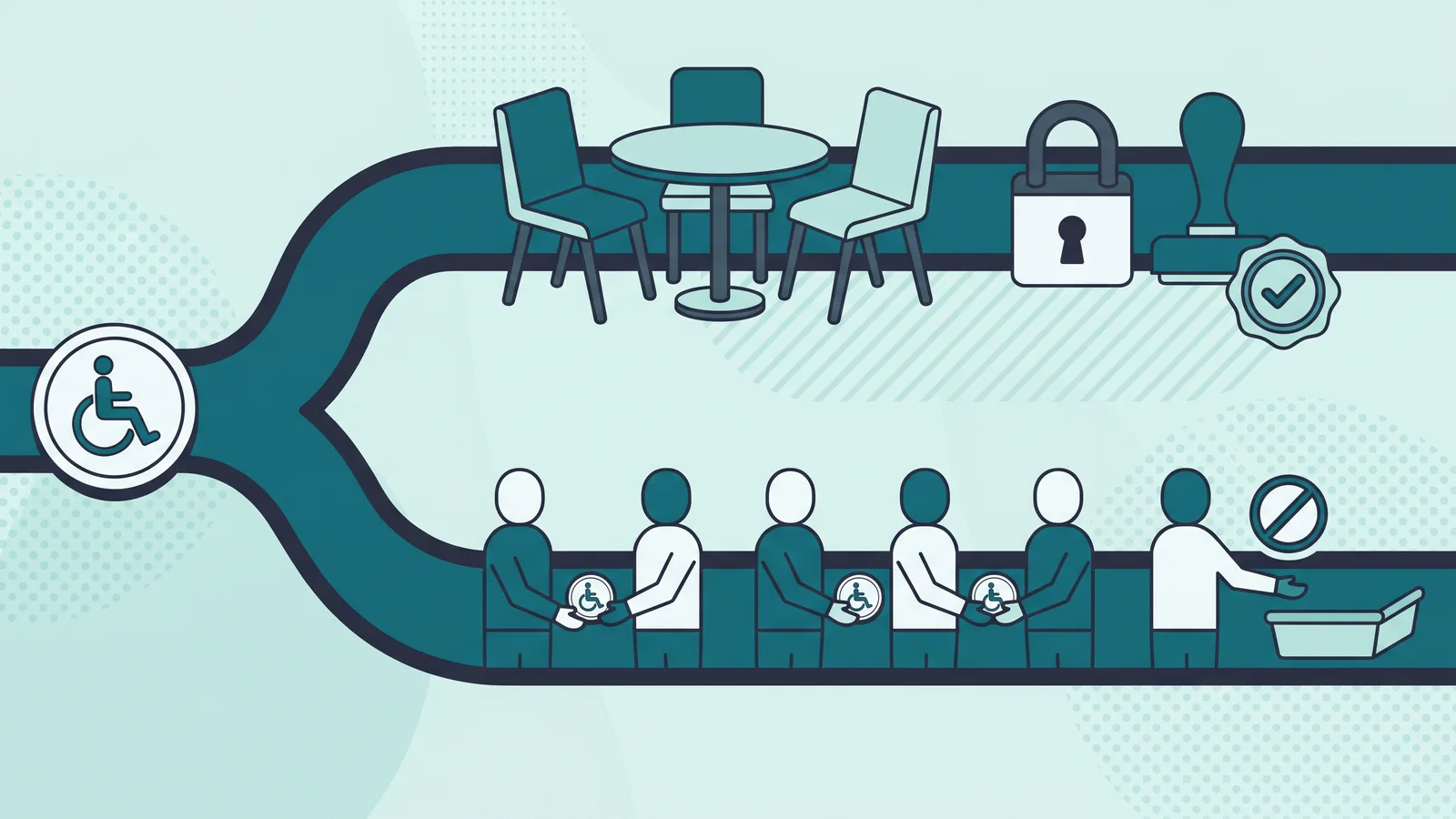
Recognition comes first. Staff learn that a request almost never sounds like one. Nobody says "I am invoking Title I"; they say "my meds make mornings rough" or "I can’t read the small labels anymore," and that has to register as a trigger rather than a grumble.
The process is taught as a workflow. A manager learns whom to notify, what to write down, which questions are allowed, what documentation may be requested, and at what point HR takes the file.
Boundaries are rehearsed, not described. Confidentiality, off-limits medical questions and retaliation get practiced in short scenarios, because the failure is nearly always verbal and immediate.
Enforcement agencies treat this as an ongoing duty rather than a one-time event. The EEOC’s Office of General Counsel Fiscal Year 2024 annual report describes a five-year consent decree that provided $1,017,500 to the charging parties and about 140 aggrieved individuals and required annual ADA training, reporting and notice posting.
Cadence and records matter more than format. If your calendar is already packed, sequencing beats volume — the approach in a six-step rebuild of annual compliance training transfers to this topic directly.
What the training must teach managers and front-line staff
Managers carry the decisions, so their syllabus should be short, procedural and tied to your own job descriptions.
- Spotting a request in plain language, including one made by a spouse, a doctor’s note handed to a shift lead, or a comment during a performance review.
- The difference between receiving a request and owing an accommodation. The request only triggers the process; the obligation is to provide a reasonable accommodation unless it would impose an undue hardship.
- What you may and may not ask about a medical condition, and who is permitted to see the answer. Where the disability or the need for the adjustment is not obvious, an employer may ask for limited documentation confirming the condition and the work limitation it creates — not a complete medical history, and not proof for an impairment that is already known or plainly visible.
- Essential functions versus marginal tasks, practiced on the actual job descriptions your supervisors use.
- The interactive process: who speaks to the employee, what gets documented, when HR takes over.
- Confidentiality mechanics — where the note is stored, who is never copied, why the team is told nothing.
- Accommodation options beyond equipment: schedule changes, modified duties, reassignment, leave.
- Undue hardship as a company determination, never a supervisor’s on-the-spot verdict.
- Retaliation patterns: sudden performance scrutiny, cut hours or an "attitude" write-up that lands after a request.
For front-line staff and peers
Awareness training has a narrower job — one behavior, repeated until it is automatic.
- Treat a coworker’s comment about a limitation as a possible request.
- Pass it to a supervisor or HR the same day, without screening it first.
- Never discuss a colleague’s condition or accommodation with the rest of the team.
- Understand that someone else’s adjusted schedule or equipment is not favoritism.
Supervisors also need wording for the uncomfortable middle of the conversation, which is where most cases are made. Scripting those exchanges sits alongside the skills covered in employee relations training for new managers.
Real examples: ADA training ordered in EEOC settlements
Consent decrees are the clearest available specification for what regulators consider adequate, and training is almost always named in them. All three settlements below come from EEOC announcements.
| Case | Payment | Training required | Other obligations |
|---|---|---|---|
| Walmart, consent decree signed Dec. 17, 2025 | Monetary settlement reported by the EEOC | Managers and human resources employees, on the ADA and reasonable accommodations | Decree resolves the EEOC’s disability discrimination suit |
| Holsum of Fort Wayne, Indiana wholesale bakery | $50,000 | Annual ADA training for HR personnel and managers | Settles EEOC disability discrimination lawsuit |
| Reliable Maintenance Solutions, Georgia quarry services | Monetary settlement reported by the EEOC | Not named in the release | Two-year decree; inform job applicants of their ADA rights; post a workplace notice about the settlement |
Read those three remedies as a checklist for your own program. Two of them name managers and HR as the required audience, one fixes the frequency at annual, and the third pushes the obligation into hiring communications — which means your applicant-facing language belongs in the same review as your course content.
Manager training vs. all-staff awareness training
Running one combined session is the most common design mistake, because the two audiences need opposite things. Managers need depth on decisions they are authorized to make and clarity on the ones they are not. Everyone else needs a short, memorable routing rule.
Split the budget accordingly: longer, scenario-based sessions with sign-off for supervisors, a brief refresher inside general onboarding for the rest of the workforce.
| Manager training | All-staff awareness training | |
|---|---|---|
| Who attends | Supervisors, hiring managers, HR | Every employee, including part-time and seasonal |
| Purpose | Run a lawful, documented process | Recognize and route, never judge |
| Core content | Interactive process, essential functions, confidentiality, retaliation | What an accommodation is, where requests go |
| Decisions covered | Documentation requests, leave, reassignment, escalation | None — escalate everything |
| Proof to keep | Attendance, scenario assessment, policy sign-off | Attendance record |
| Typical failure | A denial delivered on the spot | The request dies in a hallway conversation |
Shift-based and multi-site operations need a delivery plan before they need content; the scheduling patterns in compliance training that reaches every clinic shift solve the same coverage problem.
Common misconceptions about ADA compliance training
"Our harassment course already covers it." Harassment training teaches people what not to say; ADA training teaches managers what to do next. Disability claims sit just behind Title VII claims in the EEOC’s own litigation docket, and the conduct behind them is procedural rather than verbal.
"ADA training and digital accessibility training are the same thing." They are different obligations with different audiences. Employment training sits under Title I, while the web and mobile accessibility rules for public entities sit under Title II and set no training duty for private employers.
"Train once and we’re protected." Settlements pair training with notice posting and periodic reporting, which tells you a certificate alone is not the remedy.
"Nothing changes, so the deck can sit for three years." Guidance, job descriptions and your own case history all move; keeping HR compliance training current mid-year is cheaper than rewriting everything after an audit.
Bottom line
Teach managers a workflow and teach everyone else a routing rule. Keep the medical content minimal, the documentation standards explicit, and the scenarios drawn from jobs your company actually staffs.
Treat settlement language as your design brief: audience named, frequency named, notices and records attached. That is general information about U.S. federal law, not legal advice — state and local disability rules can set different thresholds and additional duties, so confirm yours with counsel.
Frequently asked questions
Which employers does ADA Title I cover?
Title I’s employment duties apply at the 15-employee threshold described above by ADA.gov. State and local fair-employment laws can set lower thresholds, so a smaller employer may still have obligations under its own state’s rules.
Is ADA compliance training required by law?
There is no blanket federal rule ordering every private employer to run a course. It becomes mandatory in practice through consent decrees, as the Walmart and Holsum settlements show, and it is the main evidence you have that supervisors were told how to handle a request.
How often should managers be retrained?
Annual is the defensible rhythm, and it matches what the EEOC required of Holsum of Fort Wayne, which agreed to deliver annual ADA training to HR personnel and managers. Add an off-cycle refresher whenever you change job descriptions, your request form or your escalation path.
Can one e-learning module serve both audiences?
Only if it branches. A shared ten-minute core on recognizing requests works well, with a manager-only track covering documentation, confidentiality and escalation afterward.
Who should deliver the manager session?
Someone who can answer "what do I do with this note right now" — usually HR with employment counsel reviewing the scenarios. Outside trainers work when they use your job descriptions and your request form rather than generic slides.
What records should we keep?
Attendance by name and date, the version of the material used, scenario results for supervisors, and signed acknowledgment of the accommodation policy. Decrees that require reporting assume you can produce exactly that list on short notice.
Does ADA compliance training cover website accessibility?
Employment training under Title I is a separate obligation from digital accessibility duties. A DOJ interim final rule published in April 2026 moved the Title II web and mobile compliance date from April 24, 2026 to April 26, 2027 (checked November 2026); that deadline binds public entities with populations of 50,000 or more, not private employers.
What should a manager say when an employee mentions a medical condition?
Thank them, ask what part of the job has become difficult, avoid diagnosis questions, and say that you will bring HR in to look at options. Write down the date, the work limitation described and the next step — then actually take that step the same day.
Sources
- Guide to Disability Rights Laws | ADA.gov (U.S. Department of Justice)
- FY 2027 Agency Performance Plan (APP) and FY 2025 Agency Performance Report (APR) | U.S. EEOC
- Office of General Counsel Fiscal Year 2025 Annual Report | U.S. EEOC
- Walmart to Pay $60,000 in EEOC Disability Discrimination Lawsuit | U.S. EEOC
- Holsum Settles EEOC Disability Discrimination Lawsuit | U.S. EEOC
- Reliable Maintenance Solutions to Pay $25,000 and Undertake Remedial Measures in EEOC Disability Discrimination Lawsuit | U.S. EEOC
- Office of General Counsel Fiscal Year 2024 Annual Report | U.S. EEOC
- DOJ Issues Interim Final Rule on Title II Digital Accessibility Compliance Dates | University of Arizona Digital Accessibility
AI tools helped write this guide. The HRD Lab Editorial Team published it after checking every figure against the sources linked above.