Four employee retention training types show a measurable first-year signal: structured onboarding, manager-of-new-hires training, mentor or buddy pairing, and funded upskilling. Track 45-, 90-, 180-day and 12-month survival rates to prove which one moved.

Sort your inputs by fact level before you build the case
Three bins keep a retention-training proposal honest: confirmed, reported, and never disclosed. Most decks mix all three and lose credibility in the first ten minutes of the budget meeting.
| Fact level | What belongs here | Example of the kind of claim |
|---|---|---|
| Confirmed | Government labor data and figures a company publishes about itself | BLS JOLTS separations and quits rates; Amazon’s own Career Choice participation counts |
| Reported | Percentages that circulate through vendor blogs and HR platforms | The two onboarding stats you see everywhere — one claiming a retention lift, one claiming a productivity lift — with no primary dataset attached |
| Never disclosed | Internal economics of the programs themselves | Per-head onboarding budgets, 90-day survival curves by cohort, cost-per-retained-hire at any named employer |
The total separations rate in the United States stood at 3.2% (preliminary) in August 2026, according to the BLS JOLTS home page checked in November 2026. That is the denominator your program lives inside, and it is public.
What is not public is the part executives most want: no large employer publishes its first-year retention curve by training cohort. Treat anyone who hands you a benchmark for that as a sales conversation, not evidence.
State the fact level out loud in your proposal. A slide that says "this number is reported, not confirmed" buys you more trust than a slide with a bigger number.

Background: what first-year churn actually costs you
Voluntary exits are not spiking — they are steady, which makes them easy to ignore. The U.S. quits rate, the share of employees voluntarily leaving each month, was 1.9% (preliminary) in August 2026, according to the BLS JOLTS program page checked in November 2026.
In July 2026 the number of total nonfarm quits in the United States was essentially unchanged at 3.1 million, per the BLS Job Openings and Labor Turnover Survey news release. Steady volume at that scale is the backdrop for every replacement requisition you sign.
A per-hire replacement cost figure circulates widely in recruiting marketing. This article does not repeat it, because it traces back to secondary citation rather than a primary dataset — and your finance team will check.
Build the cost side yourself instead. Add recruiter hours, agency fees, the hiring manager’s interview time, pre-boarding admin, equipment, paid training hours before productive output, and the overtime colleagues absorb during the vacancy.
That internal number is defensible because you can show the arithmetic. It also tends to surprise people, since the training hours and the coverage overtime usually dwarf the agency invoice everyone fixates on. If your training operations are scattered across spreadsheets, start with a clear map of what employee training management actually covers before costing anything.
The problem: people leave before the catalogue reaches them
Most learning catalogues are built for tenure. Leadership tracks open at the six-month mark, certification paths assume a stable role, and the "development conversation" waits for the first review cycle.
Early-tenure attrition does not wait. The exits that hurt most cluster in the first weeks, when a new hire is still deciding whether the job matches what the recruiter described.
Example: a three-shift regional distribution employer hires in weekly cohorts. Orientation is a half-day slide deck, the assigned trainer changes shift-to-shift, and the first real manager conversation happens at the review cycle. Leavers never appear in a learning report, because they churn before they are enrolled in anything.
Three failure patterns show up again and again in early-tenure exits:
- No named owner. The recruiter hands off at offer acceptance, the manager assumes HR is covering week one, and nobody owns day three.
- Role clarity arrives late. The new hire can recite the values but cannot say what "good" looks like in their own job by Friday.
- No safe question channel. Asking a basic question in week two feels like admitting you were not listening in week one.
None of those are fixed by adding courses. They are fixed by changing who does what, and when — which is why the training that moves retention is mostly manager and peer behavior, not content volume.
The solution: four training types with a first-year retention signal
Structured onboarding with a fixed 90-day arc
Replace the half-day deck with a sequence that names what the new hire should be able to do by the end of week one, week four, and week twelve. Assign each milestone an owner by job title, not by department. Pre-boarding counts: equipment, access, and a schedule sent before day one remove the most common week-one friction. Remote cohorts need their own version — a five-step plan to day-30 productivity for remote hires is a reasonable model to adapt.
Manager-of-new-hires training
Train the specific managers receiving new hires, not all managers. The curriculum is narrow: how to run a day-one role conversation, a week-two expectations check, and a 60-day "is this working" conversation without turning it into a performance review. First-time supervisors benefit from groundwork on employee relations for new managers before they inherit a cohort.
Mentor or buddy pairing
Pair every new hire with a peer at the same level on the same shift, and train the buddy for an hour on what the role is — answer questions, flag confusion upward, no evaluation. Unpaired buddies default to silence.
Funded upskilling or tuition benefits
Education benefits change the exit calculation for early-tenure hourly staff by attaching a reason to stay that the job itself may not provide. The enrolment side is documented publicly by at least one large employer; the retention side generally is not.
Which retention metrics prove it
Survival rates, not satisfaction scores. A survival rate answers one question: of the people who started in this cohort, what share is still employed at the checkpoint?
| Metric | What it catches | Who should see it |
|---|---|---|
| 45-day survival | Pre-boarding, week-one logistics, shift fit | Hiring manager, recruiter |
| 90-day survival | Role clarity, manager conversations, buddy quality | HR business partner |
| 180-day survival | Scheduling, pay progression, team dynamics | Site or function lead |
| 12-month survival | Career path and benefit uptake | Executive sponsor |
| Cost-per-retained-hire | Total program spend divided by hires still present at 12 months | CFO |
Run cohorts, not averages. Monthly or weekly start groups let you compare a trained-manager cohort against an untrained one without waiting a year for a company-wide number to move.
Segment by manager and by location before you conclude anything about the program. A single site with a scheduling problem can swamp a genuine onboarding improvement across every other site.
Cost-per-retained-hire is the number that survives a budget review. It forces training spend and recruiting spend into the same sentence, which is where the argument is actually won.
Results: what the evidence supports and what is expected by design
The honest split matters more than the headline. Confirmed public evidence covers labor-market volume and company-published participation; it does not cover causal retention lift from any specific training product.
The two onboarding percentages that dominate HR content — one for retention, one for productivity — are reported, not confirmed. They move from blog to blog without a primary dataset you can inspect, so label them as reported if you cite them at all.
Everything the four program types are expected to do should carry the tag expected by design:
- Structured onboarding is expected to raise 45-day survival because it removes week-one logistics failures.
- Manager-of-new-hires training is expected to raise 90-day survival because it creates two scheduled conversations that otherwise never happen.
- Buddy pairing is expected to raise 90-day survival by giving new hires a low-stakes question channel.
- Funded upskilling is expected to raise 12-month survival among early-tenure staff by attaching a future to the job.
Those are mechanisms, not findings. Your own cohort data converts them into findings, and that takes four checkpoints and at least a year of patience.
Report the misses too. A program that lifts 45-day survival and does nothing at 180 days is telling you the problem moved from onboarding to scheduling or pay — useful information, badly hidden by an annual average. Teams running similar programs at scale often start from onboarding training solutions sized for 50 to 500 staff.
Related real cases: Amazon Career Choice at scale
Amazon’s Career Choice education and upskilling benefit reached more than 110,000 participants in 2022, its record year of growth at the time of publication, according to Amazon’s own announcement on the About Amazon site.
More than 25,000 Amazon employees joined Career Choice within a single six-month stretch of 2022, per About Amazon — enrolment velocity that shows how fast a funded benefit can reach a large hourly workforce.
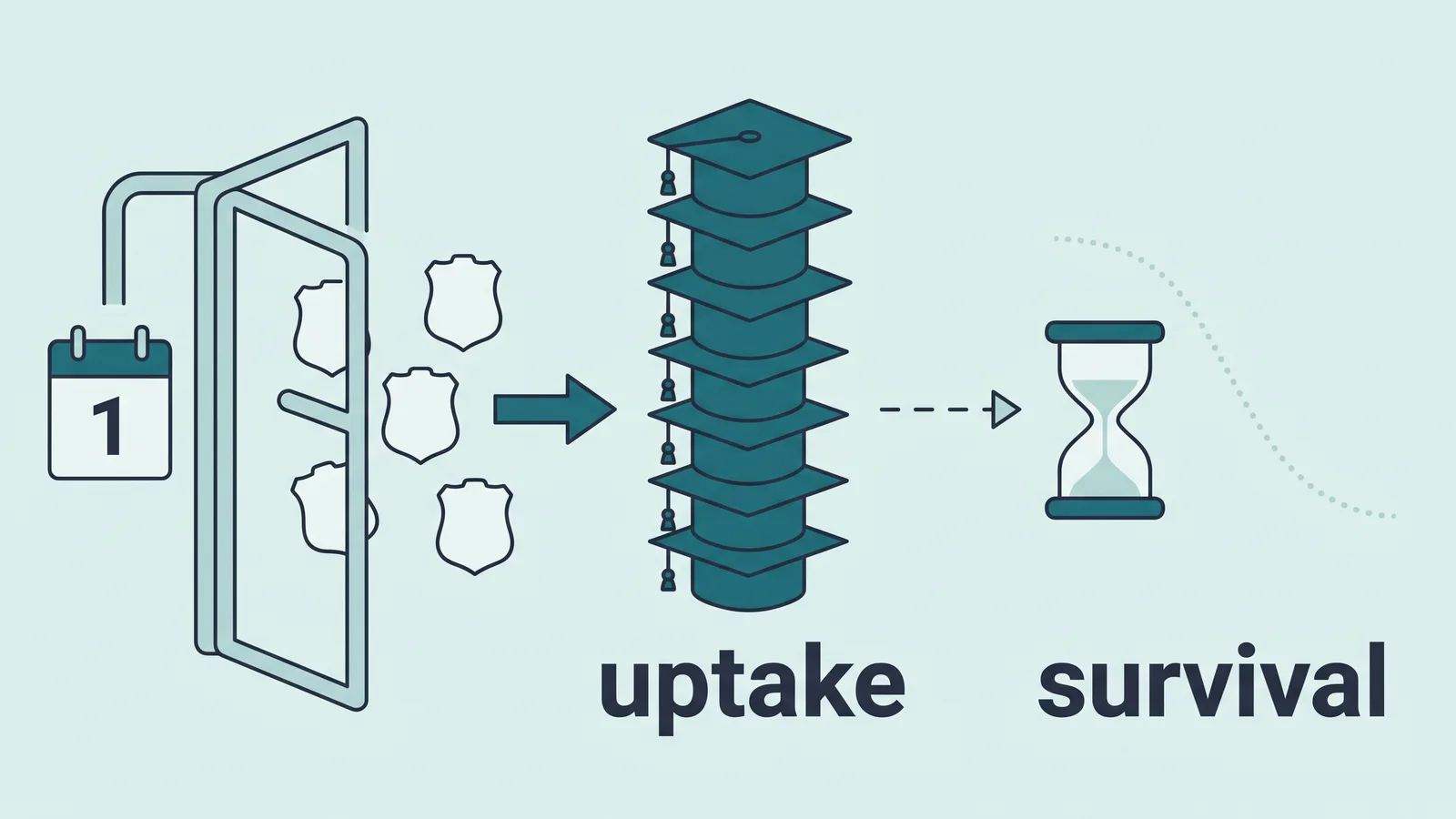
What those two figures prove is uptake, not retention. Amazon publishes participation; it does not publish a first-year survival curve for participants versus non-participants, which is exactly the number an L&D team would want.
Walmart’s Live Better U is the other large education benefit raised in this conversation. No participation or retention figure for it appears in the sources listed under this article, so none is quoted here.
Example: a 900-person seasonal retail operation could copy the structure rather than the scale — a published list of eligible programs, enrolment open from day one, and survival tracked by cohort. Seasonal patterns bring their own constraints, covered in a breakdown of training 900 seasonal retail hires.
The transferable lesson from Amazon is operational: make the benefit available early in tenure, remove the application friction, and publish the uptake number internally. Uptake you can measure this quarter; survival you measure next year.
Frequently asked questions
Which training actually reduces first-year turnover?
Four types carry a plausible first-year signal: structured onboarding with a fixed 90-day arc, training for the managers who receive new hires, trained buddy pairing on the same shift, and funded upskilling or tuition benefits. Prove each one with cohort survival rates rather than course completion counts.
What turnover data can I quote in a business case?
Use public government figures. The U.S. quits rate was 1.9% (preliminary) in August 2026 and the total separations rate was 3.2% (preliminary) in the same month, both according to the BLS JOLTS home page checked in November 2026. Those are macro context, not your company’s rate.
Why not cite the common onboarding percentages?
Those two widely repeated onboarding stats belong in the "reported" bin, not the "confirmed" bin, because they circulate between secondary sources without an inspectable primary dataset. Cite them only with that label, or skip them and bring your own 45-day and 90-day cohort numbers instead.
How soon will a new program show results?
Your earliest honest read is the 45-day survival rate for the first cohort that went through the changed process. The 90-day number tests manager conversations and buddy quality, 180 days tests scheduling and pay, and the 12-month figure plus cost-per-retained-hire is what finance will debate.
Do education benefits like Amazon Career Choice keep people longer?
Amazon has published uptake, not retention: Career Choice reached more than 110,000 participants in 2022 and added over 25,000 employees in a six-month stretch that year, according to About Amazon. Treat the retention effect as expected by design until your own cohort data confirms it.
Sources
AI tools helped write this guide. The HRD Lab Editorial Team published it after checking every figure against the sources linked above.