Run employee relations training as practice, not policy reading: map the real cases new managers face, set escalation and documentation non-negotiables, teach five core conversations, then rehearse them with HR shadowing inside the first 90 days.
Quick steps
- Pull the last 12 months of employee relations cases and sort them by who touched them first.
- Write one page of non-negotiables: what the manager decides alone, what reaches HR the same day.
- Build the curriculum around five conversations, not the policy manual.
- Rehearse those conversations with role-play and HR shadowing inside the manager’s first 90 days.
- Review case quality, time-to-escalation and manager confidence every quarter.
Why employee relations training pays off fastest for new managers
A first-time manager inherits the hardest part of the employment relationship on day one: the conversations. They decide whether a late start is a pattern or a bad week, whether a complaint is a grievance or a gripe, and whether anything gets written down at all. Gallup’s 2025 State of the Global Workplace report found that only 44% of managers worldwide have ever received any management training.
Untrained decisions do not stay small. A skipped documentation step in March becomes the weak link in a dismissal review in September, and the cost lands on HR, not on the manager who shrugged it off.
Employee relations training also protects the manager. Most new supervisors are promoted because they were strong individual contributors, and the skill that got them promoted — doing the work themselves — is the exact instinct that makes them avoid a hard conversation until it hardens into a case.
The return is quick because the volume is high. A single frontline manager may handle dozens of small friction points in a quarter: shift swaps, a missed deadline, a comment in a team channel, a request for leave. Train the first 10 minutes of each of those and you change the rest.
Step 1 — Map the employee relations situations your new managers will actually face
Time: two to three hours. Materials: 12 months of case data, exit interview themes, and five 20-minute manager interviews.
Start with your own case log rather than a generic competency model. Strip names, then sort every case by what triggered it, who handled it first, and how long it sat before HR heard about it. Patterns show up fast — attendance and interpersonal friction usually dominate, with pay and scheduling errors close behind.
Add the near-misses. Ask three experienced managers what they handled last quarter that never became a case, because those are the situations your new managers will meet before they ever meet a formal grievance.
The Chartered Management Institute found that 82% of UK managers enter management roles with no formal management or leadership training, which is why they are often called "accidental managers". Your map is the antidote: it tells you which five or six situations are worth rehearsing and which are rare enough to handle by escalation alone.
Group the results into categories a manager would recognise, not categories a lawyer would use:
- Attendance, lateness and unplanned absence
- Performance gaps after a clear expectation was set
- Conflict between two team members
- Complaints about a manager, including the new manager themselves
- Requests that may need accommodation, leave or a pay correction
- Conduct incidents: language, harassment allegations, safety breaches
If you run seasonal or high-volume hiring, weight the map toward the first six weeks of employment, where most of your friction sits. The same sequencing logic shows up in this breakdown of how one retailer trained 900 seasonal hires without losing the first-week basics.
Step 2 — Set the non-negotiables: policy, escalation routes and documentation standards
Time: one week of drafting and legal review. Materials: current handbook, grievance procedure, HRIS case fields.
New managers do not need the handbook. They need a one-page decision rule that tells them where their authority ends, written in plain sentences and signed off by your employment counsel.
| Situation | Manager handles | HR same day | ER specialist or counsel |
|---|---|---|---|
| First missed deadline or late start | Yes, private conversation | No | No |
| Repeat performance gap after coaching | Yes, with written note | Notify | No |
| Complaint about a colleague’s conduct | Listen, do not investigate | Yes | If harassment alleged |
| Pay, leave or accommodation request | Acknowledge only | Yes | If medical or legal issue |
| Safety breach or threat | Stop the activity | Yes | Yes |
Set the documentation standard in the same page: what the manager writes, where it lives, and how soon. A workable rule is a dated note within 24 hours containing what was observed, what was said, what was agreed, and the review date — facts only, no diagnosis of motive.
SHRM research found that US workers who experienced or witnessed an act of incivility at work lost an average of 36 minutes of productivity per act, which is a useful reason to treat small conduct issues as worth a same-week note rather than a shrug.
Jurisdiction matters. These routes assume US-based private employers, and the rules differ by state — and differ again for public-sector employers, unionised sites and teams outside the US, where consultation or works council obligations may apply before any disciplinary step. This is general information, not legal advice; have counsel confirm your escalation page.
Step 3 — Build the curriculum around a short list of core conversations
Time: two to three weeks to write. Materials: your Step 1 map, the Step 2 one-pager, real anonymised scenarios.
Teach five conversations. Not twelve modules, not a policy tour.
- The expectation reset — restating a standard before it becomes a performance case.
- The documented performance conversation — observed facts, agreed actions, review date.
- Receiving a complaint — listen, record, escalate, never promise confidentiality you cannot keep.
- The availability conversation — absence, scheduling and the moment a request becomes an accommodation question for HR.
- The incivility repair — naming behaviour in the moment and closing the loop with both people.
Give each one the same spine: open in two sentences, state the observed fact, ask one question, agree a next step, confirm in writing. Managers remember a spine; they forget a script.
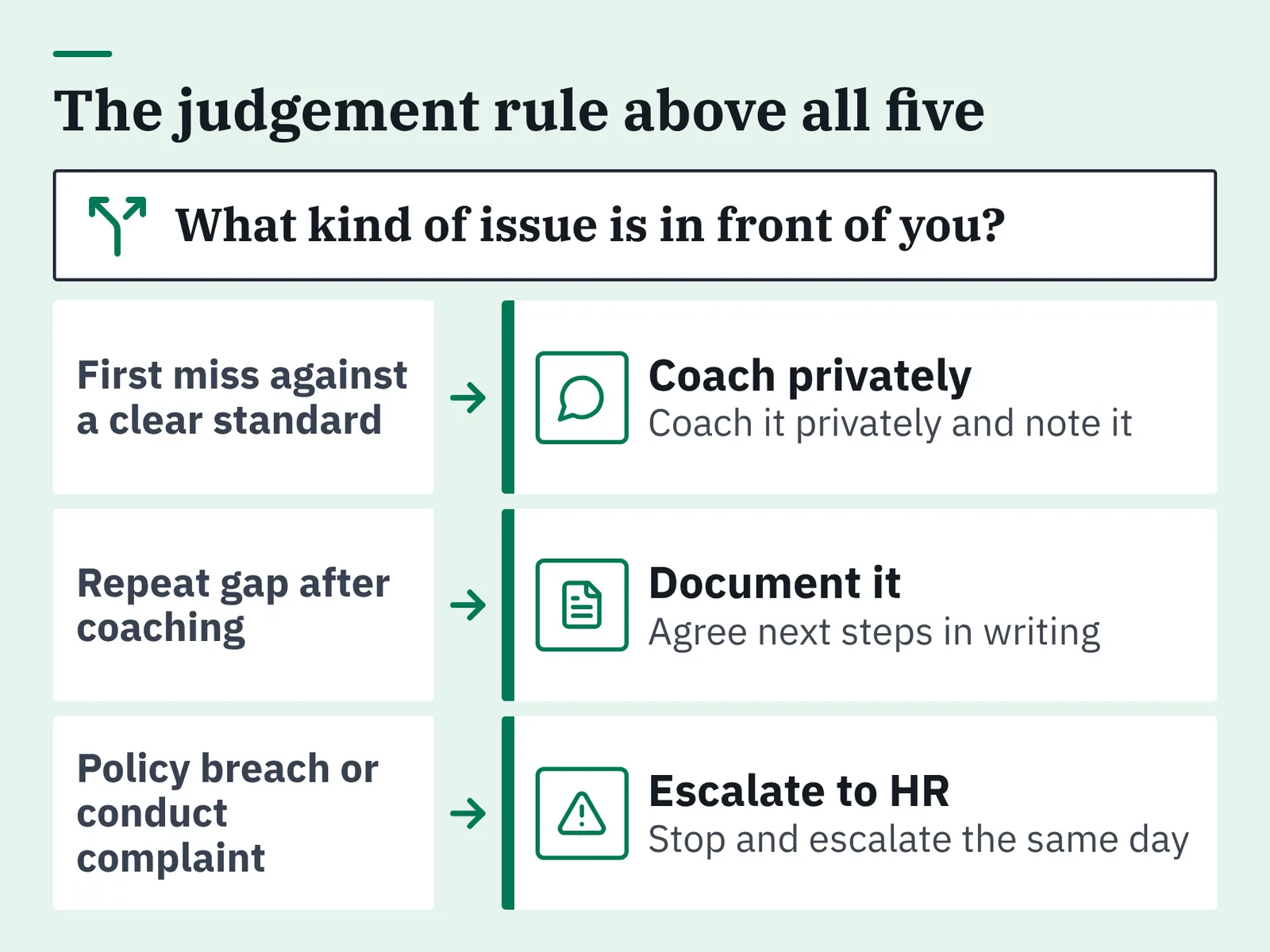
The judgement rule sits on top of all five. If it is a first miss against a clear standard, coach it privately and note it. If it is a repeat gap after coaching, document it and agree next steps in writing. If it is a policy breach or a complaint about conduct, stop and escalate to HR the same day.
SHRM’s Q4 2024 Civility Index estimated that US organisations were losing more than $2.7 billion per day through reduced productivity linked to workplace incivility — which is the business case for teaching conversation five, not just conversation two.
Step 4 — Deliver it as practice: scenarios, role-play and HR shadowing in the first 90 days
Time: roughly six to eight hours spread across 90 days. Materials: scenario cards from Step 1, an observer checklist, two HR shadowing slots per manager.
Split delivery into short live sessions of 90 minutes each, one per core conversation, with no more than eight managers in a room. Reading comes before the session; the room is for rehearsal only.
Run role-play in rounds of about eight minutes: manager, employee, observer, then rotate. The observer scores against four things — did the opening stay under 30 seconds, were the facts observable, was one question asked, was a review date agreed.
Pair every session with shadowing. Each new manager sits in on two real HR-led conversations in their first 90 days, with consent and a debrief, because watching an experienced ER partner pause before answering teaches more than any slide.
Gallup reports that in 2024 just 45% of US employees took part in any training or education to build new skills for their current job, so assume your managers’ default is no practice at all and schedule the sessions into their calendar before they start the role.
Record model versions of the five conversations for refreshers and for managers who join between cohorts. Keeping that production in-house is cheaper than most teams expect, as this guide to running corporate training video production without an agency sets out. Slot the whole sequence into the manager’s onboarding path rather than a separate calendar, the way a custom onboarding program is sequenced to scale across sites.

Step 5 — Measure impact with case data and manager confidence, not smile sheets
Time: one hour per quarter. Materials: case management export, a five-question confidence pulse.
Satisfaction scores tell you the room was comfortable. Case data tells you whether behaviour changed.
Track five things each quarter:
- Time from first concern to first documented conversation — should shorten.
- Share of escalations arriving with notes attached — should rise.
- Repeat cases from the same team within 90 days — should fall.
- Cases that reached HR already resolved for information only — should rise.
- Manager confidence on each of the five conversations, rated before training and 90 days after.
Gallup data cited in trade press shows that managers who have had formal management training are half as likely to be actively disengaged as untrained managers, which makes the manager’s own engagement a fair secondary measure of your program.
Read the numbers with context. A rise in reported cases in the first two quarters usually means managers started surfacing things they previously buried, and that is the result you wanted — the quality measure is whether those cases arrive documented and early.
Publish a one-page quarterly summary to the managers themselves. Showing a cohort that their median time-to-first-conversation dropped does more for attendance at the next session than any invitation email.
Employee relations training checklist for first-time managers
Use this before a cohort starts and again at day 90. Every item is something you can show evidence of, not something you can claim.
- ☐ Twelve months of case data mapped into six or fewer situation categories
- ☐ One-page escalation table signed off by employment counsel
- ☐ Documentation standard defined: what, where, within 24 hours
- ☐ Five core conversations written with the same five-part spine
- ☐ Scenario cards drawn from real anonymised cases, names and sites removed
- ☐ Role-play observer checklist with four observable criteria
- ☐ Two HR shadowing slots booked per manager inside 90 days
- ☐ Named ER contact for every manager, with response-time expectation
- ☐ Confidence pulse run before training and at day 90
- ☐ Quarterly case review booked with the operations leader, not just HR
Keep the checklist with the manager’s onboarding record so it survives a change of HR business partner. Teams that automate the reminders rather than the judgement get the best of both, a balance covered in this look at where onboarding automation helps and where it costs you people.
Common mistakes HR makes when training first-time managers
The biggest failure is treating promotion day as the only training moment. A manager trained once in January faces their first real grievance in June with a half-remembered slide, and the avoidance is cheap: run a 30-minute clinic each month where managers bring one live situation and talk it through with an ER partner.
Other patterns worth avoiding:
- Teaching policy instead of language. Managers quote the handbook and still cannot open the conversation.
- Scenarios invented by the trainer. Use real anonymised cases or managers will dismiss the exercise.
- No named HR contact. Escalation routes fail when the route ends at a shared inbox.
- Confidentiality promised in the room. A manager who says "this stays between us" has created your next problem.
- Skipping the operations leader. If the manager’s director rewards speed over documentation, your training loses.
SHRM’s Q3 2025 Civility Index put the daily cost of incivility to US organisations at about $2.14 billion in lost productivity and increased absenteeism, so the monthly clinic is a small line item against the alternative.
Watch the handover too. When an experienced manager leaves, their undocumented history leaves with them, and the new manager restarts every performance conversation from zero.
Frequently asked questions
How long should employee relations training for first-time managers take?
Plan roughly six to eight hours of live practice spread across the manager’s first 90 days, split into 90-minute sessions of no more than eight people, plus two HR shadowing slots and a monthly 30-minute clinic afterward.
What should a new manager handle alone, and what goes to HR?
A first miss against a clear standard is the manager’s to coach and note. Repeat gaps get documented with HR notified. Complaints about conduct, pay, leave or accommodation requests go to HR the same day.
Why do so many new managers avoid employee relations conversations?
Most were promoted for individual performance and never trained to supervise. The Chartered Management Institute found that 82% of UK managers enter management roles with no formal management or leadership training, making them "accidental managers".
How do I prove employee relations training worked?
Compare case data before and after: time from first concern to first documented conversation, share of escalations arriving with notes, repeat cases within 90 days, and manager confidence rated on each core conversation at day 90.
Is employee relations training the same as compliance training?
No. Compliance training covers legal obligations and recordkeeping; employee relations training teaches the conversation itself — opening, observable facts, one question, agreed action, review date. SHRM research found US workers lost an average of 36 minutes of productivity per act of incivility experienced or witnessed.
Sources
- How Managers Impact Team Productivity — Gallup
- Engagement on the Decline: Why Managers Hold the Key to Reversing It — Lab Manager
- Better Management Report: Take Responsibility, Take Action — Chartered Management Institute
- The Cost of Incivility: Addressing Workplace Challenges into 2025 — SHRM
- New Data Shows Managers Could Do More to Curb Incivility at Work — SHRM
- How CHROs Can Handle a Workplace Confrontation with Civility — SHRM
- Addressing the Barriers Blocking Employee Development — Gallup
AI tools helped write this guide. The HRD Lab Editorial Team published it after checking every figure against the sources linked above.